Court decision
Asked your religion in a job interview? Act within a year
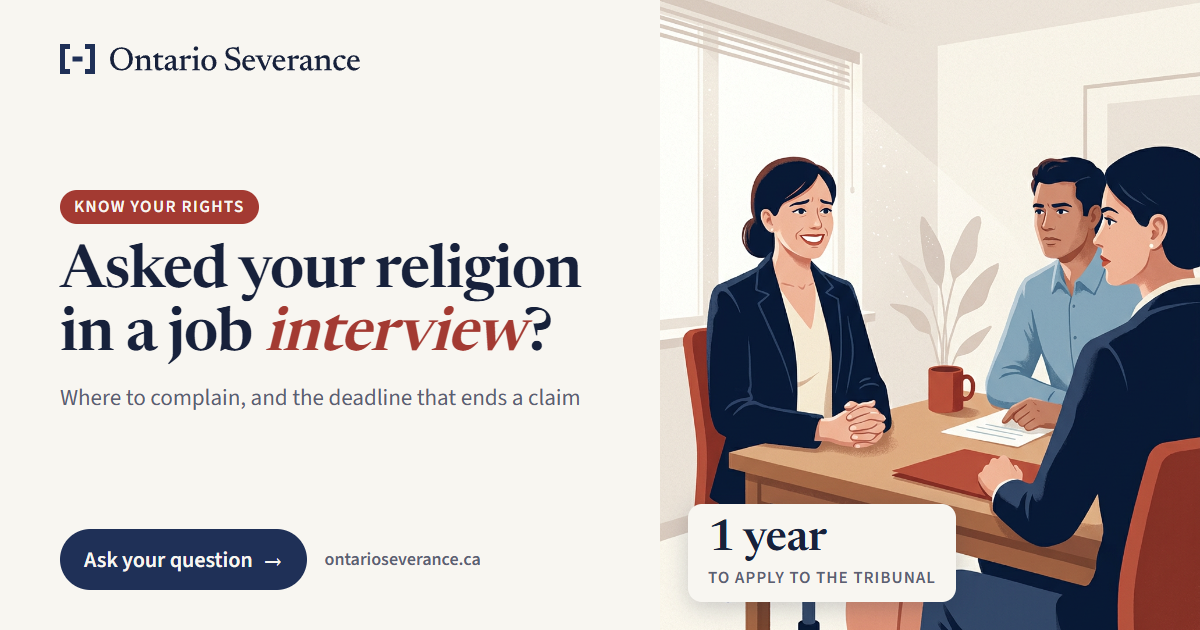
An interviewer asks where you were born, what religion you practise or whether you plan to have kids. In Ontario, those questions are generally off-limits. But a Court of Appeal ruling shows how a complaint about them can be lost: filed in the wrong place, years too late.
What the court decided
In 2015, a man interviewed for a job at Rogers Communication. He says he was asked about his country of origin, his religion and his family history. In 2022, about seven years later, he sued the company in the Superior Court for damages for discrimination.
The court struck his claim, and on February 13, 2026 the Court of Appeal dismissed his appeal in H.E. v. Rogers Communication, 2026 ONCA 111. It gave two reasons:
- No lawsuit for discrimination alone. There is no common law tort of discrimination, as the Supreme Court of Canada held in Seneca College v. Bhadauria. Rogers is federally regulated, so the Canadian Human Rights Act applied, and the motions judge found that Act doesn't let a complainant go to court instead.
- Too late. The two-year limitation period for lawsuits had long run out. He said his health had kept him from suing. But the law presumes you are able to sue, and he had started other lawsuits in those years.

Which questions cross the line?
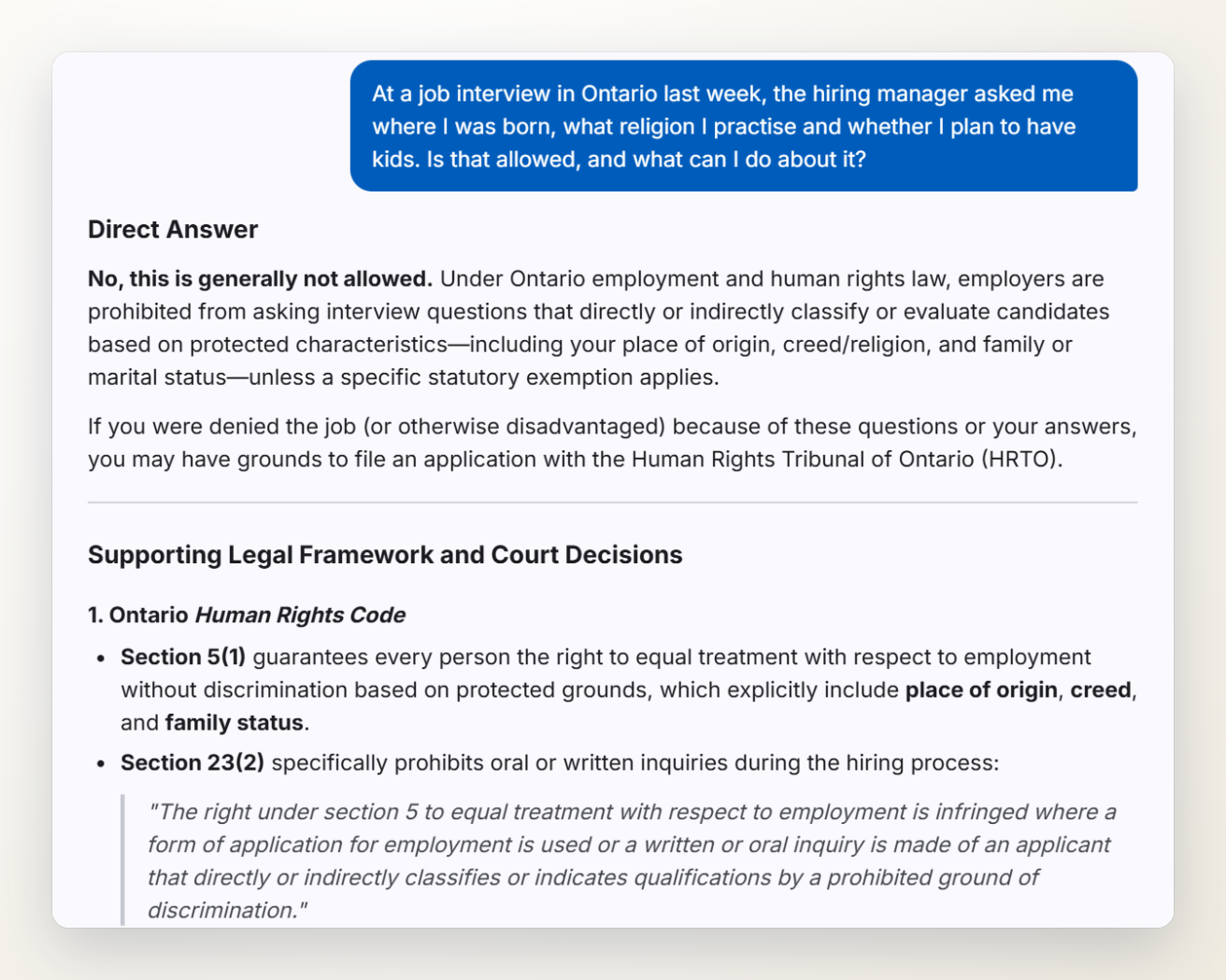
Ontario's Human Rights Code says your right to equal treatment in employment is infringed when an application form, or "a written or oral inquiry" made of an applicant, classifies people by a prohibited ground (s. 23(2)). Those grounds include place of origin, ethnic origin, creed, age, marital status, family status and disability (s. 5(1)).
Narrow exceptions exist, such as a religious or social organization serving a particular group (s. 24), and only then may an interviewer ask (s. 23(3)).
At federally regulated employers, such as banks, airlines and telecom companies, the federal Act says the same: a written or oral inquiry that expresses a preference based on a prohibited ground is a discriminatory practice (s. 8).
Where to go, and how fast
- Most Ontario employers: apply to the Human Rights Tribunal of Ontario within one year of the incident, or of the last one in a series (Code s. 34(1)). The Tribunal can accept a late application only if the delay was in good faith and harms no one (s. 34(2)).
- Federally regulated employers: complain to the Canadian Human Rights Commission. It can refuse a complaint about events more than a year old (federal Act, s. 41(1)(e)).
- A court: only together with another claim, such as wrongful dismissal. The court can then also award damages for the discrimination (Code s. 46.1).
Not sure which rules apply?
Tell the chat what happened and who the employer is: it explains the rules and the deadline. Or read court decisions on workplace discrimination.
Ontario Severance is independent and isn't a law firm; this is general information. From a chat or a calculator result, you can ask us for help finding an employment lawyer, and we reply within one business day.
Sources
- H.E. v. Rogers Communication, 2026 ONCA 111
- Human Rights Code, R.S.O. 1990, c. H.19, ss. 5, 23, 24, 34 and 46.1
- Canadian Human Rights Act, R.S.C. 1985, c. H-6, ss. 3, 7, 8 and 41
- Government of Canada: List of federally regulated industries and workplaces
- Canadian Human Rights Commission: File a discrimination complaint
This article is general information about Ontario employment law, not legal advice. The law and its application change, and every case turns on its own facts: for advice about your situation, speak with an Ontario employment lawyer.