Court decision
WSIB said no? Your human rights claim may not be over
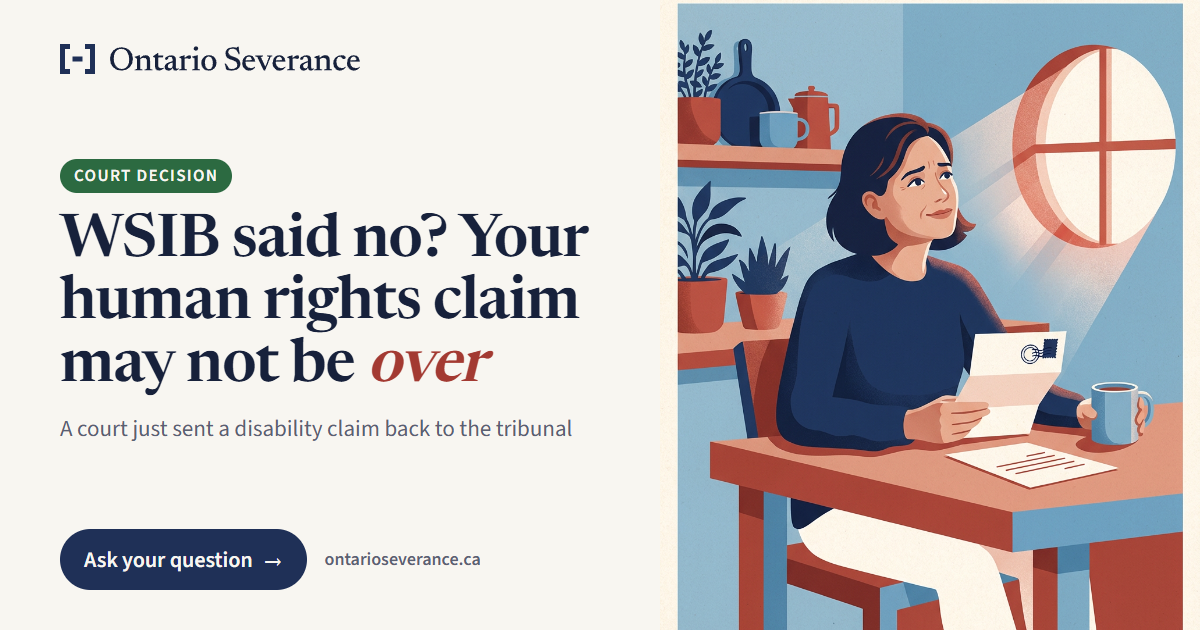
You asked for time off with a doctor's note. Your employer said no. Then the WSIB turned down your claim too. Is that the end of it? Not necessarily, Ontario's Divisional Court said on September 28.
What happened
- 2019: an employee was refused time off backed by a doctor's note. She applied to the Human Rights Tribunal of Ontario (HRTO), alleging discrimination because of disability.
- 2020: her employment was ended. She filed a claim with the WSIB for chronic mental distress caused by her workload. The WSIB later said no: a failure to accommodate may be a problem, but it isn't workplace harassment, so the WSIB had no remedy for it.
- May 2025: the HRTO dismissed her application without a hearing, deciding the WSIB had already dealt with the same issues.
- September 28, 2026: three judges of the Divisional Court called that "plainly unreasonable". The WSIB had expressly set the accommodation issue aside as outside its mandate. It hadn't decided it; it had only excluded it. The dismissal was quashed and the case goes back to the HRTO.
The court didn't decide whether the employer discriminated. That is now for the tribunal.

Why a WSIB "no" didn't end it
The Human Rights Code lets the tribunal dismiss an application when "another proceeding has appropriately dealt with the substance" of it (s. 45.1). Sharing the same facts isn't enough. Here the WSIB had asked whether there was a compensable injury, not whether the employer had to accommodate a disability.
That second question belongs to the Code. It guarantees equal treatment at work without discrimination because of disability (s. 5), which includes a mental disorder and an injury someone claimed WSIB benefits for (s. 10). An employer must accommodate up to undue hardship (s. 17).
Watch the one-year deadline
- An application to the HRTO is due within one year of the incident, or of the last one in a series (s. 34(1)).
- The Code doesn't pause that year while the WSIB decides. A late application is accepted only if the delay was in good faith and causes no substantial prejudice (s. 34(2)). The employee here filed in 2019, before the WSIB ruled.
- If the tribunal finds discrimination, it can order compensation, including for injury to dignity, feelings and self-respect (s. 45.2).
Lost your job too? Courts can award more than the minimum the law guarantees. Our calculator shows both, and our guide explains why an ESA claim can cost you the right to sue.
Our page on M. v. Direct Coil Inc. has the details, and there are more human rights decisions →
Ontario Severance is independent and isn't a law firm; this is general information. From a chat or a calculator result, you can ask us for help finding an employment lawyer, and we reply within one business day.
Sources
This article is general information about Ontario employment law, not legal advice. The law and its application change, and every case turns on its own facts: for advice about your situation, speak with an Ontario employment lawyer.