
Know your rights
Laid off after 20 years? Here's what you're owed, at minimum

Twenty years in the same job, and now there's talk of cuts. Can your employer pay you less, or nothing, because money is tight? No. Here's the floor Ontario law sets, and why it's often only the start.
A budget cut isn't "cause"
When your job is cut to save money, you're let go without cause. Under the Employment Standards Act (ESA), only a short list of situations takes away termination and severance pay, mainly wilful misconduct, disobedience or wilful neglect of duty that isn't trivial and hasn't been condoned. A deficit isn't one of them.
One exception: turn down your employer's offer of reasonable alternative work, and you can lose both.
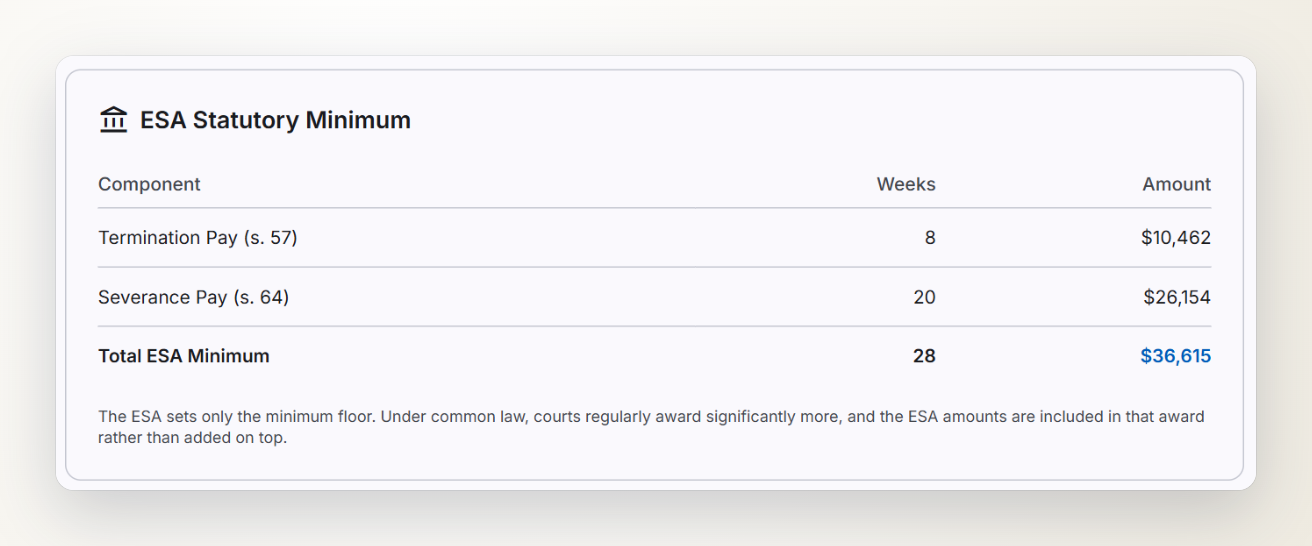
Your ESA floor after 20 years: 28 weeks
- Termination pay: 8 weeks, the ESA maximum, reached at 8 years. Your employer can give it as working notice instead: you keep working, at your usual pay and benefits.
- Severance pay: 20 weeks, 1 week per year of service (up to 26), on top of termination pay. It applies from 5 years of service if your employer's payroll is $2.5 million or more, or if 50 or more people lose their jobs within 6 months when all or part of the business at a location closes for good. It's always paid as money, never as working notice.
Told the layoff is temporary? A layoff that lasts longer than the ESA allows (more than 13 weeks in any 20, or longer in some cases) counts as a termination. Read decisions on temporary layoffs →
Common law: often more than the minimum
If you're not in a union, you may also be owed reasonable notice: the notice, or pay in its place, that courts award.
No formula sets it. Courts weigh your age, length of service, kind of job and how easy it will be to find similar work (Bardal v. Globe & Mail Ltd., 1960). Ontario's Court of Appeal rejected a "month per year of service" rule of thumb in Minott v. O'Shanter Development Company Ltd. (1999).
A termination clause in your contract can limit you to the ESA minimum, but only if it's valid, so it's worth having yours checked. Read decisions on termination clauses →

Before you sign anything
An offer may come with a release, where you give up the right to claim more. The ESA says no one can waive its minimums, so a release can't take those away, only what's above them. Ask for time, and get advice before you sign.
See your own minimum, and what courts awarded in cases like yours.
Ontario Severance is independent and isn't a law firm; this is general information. From a chat or a calculator result, you can request a free initial consultation.
Sources
- Employment Standards Act, 2000, ss. 5, 54 to 66 (s. 56 temporary lay-off, s. 57 notice, s. 61 pay instead of notice, ss. 64 and 65 severance pay)
- O. Reg. 288/01 (Termination and Severance of Employment), ss. 2 and 9
- Your guide to the Employment Standards Act: Termination of employment (Government of Ontario)
- Your guide to the Employment Standards Act: Severance pay (Government of Ontario)
- Bardal v. Globe & Mail Ltd., 1960 CanLII 294 (ON SC)
- Minott v. O'Shanter Development Company Ltd., 1999 CanLII 3686 (ON CA)
This article is general information about Ontario employment law, not legal advice. The law and its application change, and every case turns on its own facts: for advice about your situation, speak with an Ontario employment lawyer.