Know your rights
Let go just short of 5 years? Count your time again

Let go after 4 years and 11 months? Under Ontario's Employment Standards Act, five years is the line for severance pay, and a few weeks can decide whether you get it. Before you accept that you fell short, check what the Act actually counts.
Two payments, two different rules
The Act has two separate minimums. Termination pay (pay in place of notice) starts after 3 months of employment: 4 weeks if you worked 4 years but fewer than 5, 5 weeks from 5 years, up to 8 weeks (s. 57).
Severance pay is on top of that, and only if you worked 5 years or more and your employer has a payroll of $2.5 million or more, or let 50 or more people go within six months because it permanently closed all or part of its business at a location (s. 64). It is one week of regular wages per year, counting completed months too, up to 26 weeks (s. 65).
Take a made-up example of someone earning $1,000 a week at a large employer. Let go at 4 years and 11 months, their ESA minimum is $4,000 of termination pay. At 5 years, it is $5,000 of termination pay plus $5,000 of severance pay: $10,000, before vacation pay.

What counts toward your 5 years
- Earlier stints with the same employer. All the time you were employed counts, "whether or not continuous and whether or not active" (s. 65(2)). Left and came back? Add both. (The exception: time already credited in an unreduced pension you're receiving, s. 65(2.1).)
- Time on leave. A leave doesn't stop the clock: inactive time counts too (s. 65(2)).
- Working notice. If you're told to keep working until a set date, you're employed until then, and those weeks count. If you're let go without the notice the Act requires, the amount of severance pay is calculated as if you had worked through it (s. 65(4)).
So someone who seems a few weeks short may reach five years once earlier periods, leaves and worked notice are counted. Write down your start date, earlier periods and leaves, and ask how your employer counted them.
Courts don't stop at 5 years
The five-year line is only in the Act. Unless a valid contract clause limits you to the ESA minimum, courts award reasonable notice, which has no such threshold.
In D.C. v. Arista Homes Limited, an employee let go after 4 years and 9 months was paid 4 weeks, the ESA minimum, under the contract. The court found the contract's for-cause clause broke the Act, so the employer couldn't rely on its termination clause, and awarded 8 months' salary in place of notice, and the Court of Appeal upheld it in 2025.
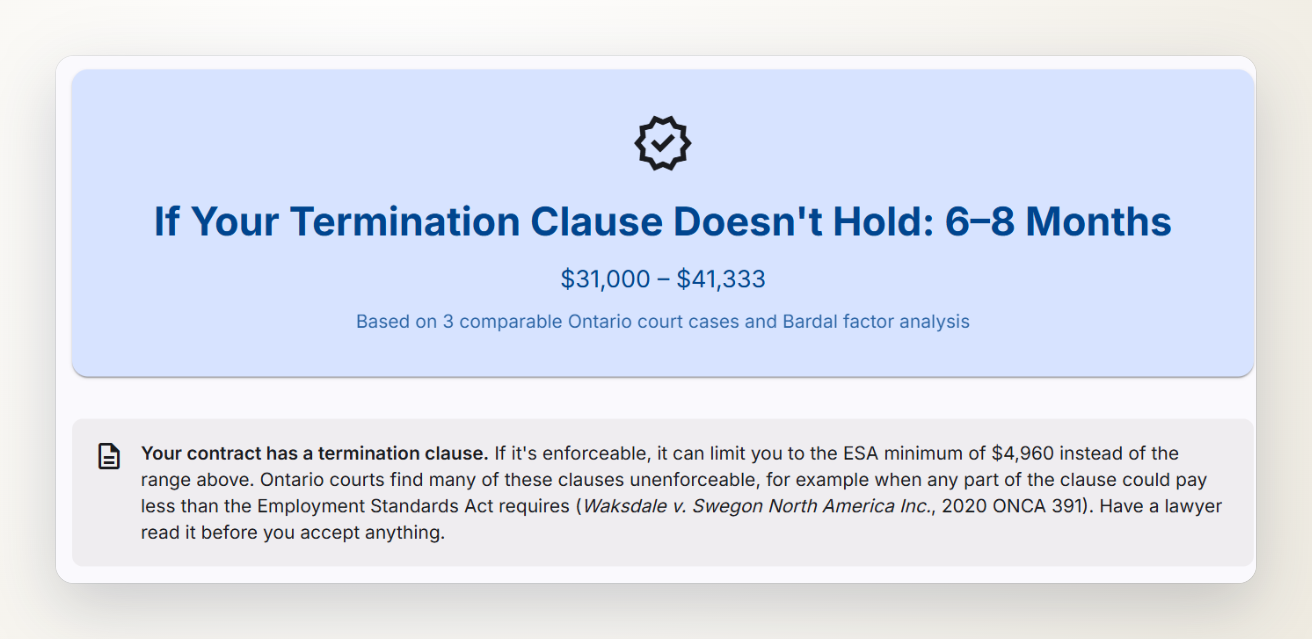
Our calculator shows both: your ESA minimum and what courts awarded in cases like yours. Ask your question →
Ontario Severance is independent and not a law firm; this is general information. From a chat or a calculator result, you can ask us for help finding an employment lawyer, and we reply within one business day.
Sources
- Employment Standards Act, 2000, ss. 57, 64 and 65 (e-Laws, current to October 30, 2026)
- Your guide to the Employment Standards Act: Severance pay (Government of Ontario)
- Your guide to the Employment Standards Act: Termination of employment (Government of Ontario)
- D.C. v. Arista Homes Limited, 2025 ONCA 260 (Court of Appeal for Ontario)
This article is general information about Ontario employment law, not legal advice. The law and its application change, and every case turns on its own facts: for advice about your situation, speak with an Ontario employment lawyer.