Know your rights
Ontario education strike votes: what the law says
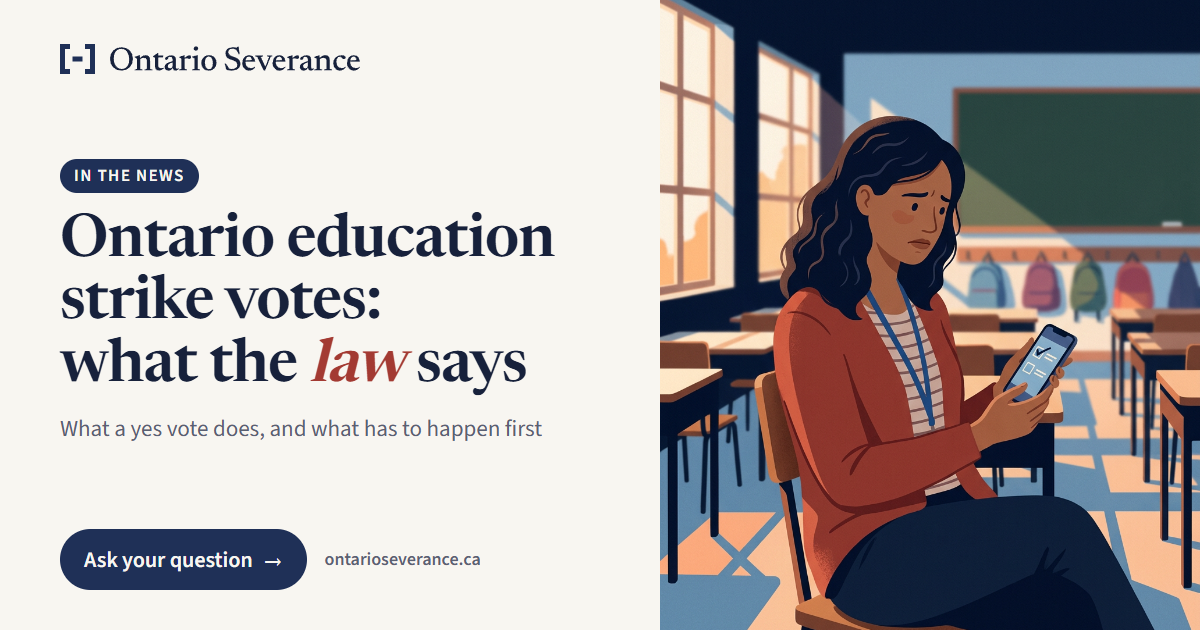
From November 4, teachers and education workers across Ontario vote on whether to give their unions a strike mandate. If you work in a school, you probably have questions: does a yes vote mean a strike? When could one start? Can you lose your job over it? Here is what the reports say, and what the law says.
The facts so far
- August 31, 2026: the collective agreements of the five main education unions expired, as reported by NOW Toronto and The Conversation.
- September 25: the high school teachers' union, OSSTF, announced its strike vote, The Canadian Press reported. The Education Minister's office said the government would negotiate once a labour board process ends, and called strike threats premature.
- October 26: The Globe and Mail reported that bargaining is stalled over which issues are negotiated with the province and which with each school board, and that the Ontario Labour Relations Board's ruling on it is expected in early November.
- October 29: The Conversation put Ontario's education workforce at about 255,000.
The voting dates, as announced by the unions and reported by The Globe and Mail and NOW Toronto:
| Union | Who it represents | Vote |
|---|---|---|
| CUPE-OSBCU | About 57,000 education workers | Nov. 4 to 18 |
| OSSTF | Over 60,000, mostly in high schools | Nov. 6 to 16 |
| ETFO | About 84,000 in elementary schools | Nov. 9 to 18 |
| OECTA | About 45,000 in Catholic schools | Nov. 12 and 13 |
| AEFO | More than 13,000 members, mostly teachers in French-language schools (the vote is for its teachers) | Nov. 16 and 17 |
No strike has been called, and none of the reports mentions a strike date.
What a yes vote does
A strike vote is a mandate, not a strike. Under the Labour Relations Act, 1995 (s. 79(3)), employees whose agreement has expired can only strike after a vote in which more than 50% of those voting say yes. The vote is by secret ballot, and every employee in the bargaining unit may take part, whether or not they are a union member (s. 79(7) and (8)).
In schools, central bargaining (with the province) and local bargaining (with each board) are treated separately for these rules, under the School Boards Collective Bargaining Act, 2014 (s. 34(1)).
What has to happen before any strike
A yes vote alone isn't enough. The law adds three steps:
- Conciliation. The Minister of Labour must appoint a conciliation officer or mediator. A strike becomes possible only once 16 days have passed after the Minister sends notice that no conciliation board will be appointed (the "no-board" report), or 9 days after the Minister releases a conciliation board's or mediator's report (s. 79(2)). In schools, these steps run separately for central and local bargaining (School Boards Collective Bargaining Act, s. 34(1)).
- Five days' written notice. The union must give at least five days' written notice of the strike and its start date: to the employer side and the province for central issues, to the school board for local ones (School Boards Collective Bargaining Act, s. 34(3) and (4)).
- Not over the scope dispute itself. No strike can be called because the sides can't agree whether an issue is central or local (s. 28(2)). That dispute goes to the Labour Relations Board (s. 28(4)), which is where it is now.
So even with strong mandates, a legal strike is still several steps away.
Your rights if a strike happens
- No firing without just cause. From the day a strike or lock-out becomes lawful until a new agreement is reached (or the union stops representing the unit), the employer can't discharge or discipline anyone in the bargaining unit without just cause (Labour Relations Act, s. 80.1).
- A right to come back. During a lawful strike, an employee who asks in writing, without conditions, to return to work within six months of the start of the strike must be reinstated in their former job, unless the employer no longer has anyone doing the same or similar work, or has suspended or stopped operations for cause (s. 80).
- An unlawful strike is different. A union can't call or support a strike that skips these steps (s. 81), and the protections above apply to lawful strikes.
Can the province order everyone back?
The government can pass back-to-work legislation, and the courts have ruled on it. In 2015 the Supreme Court of Canada held that the right to strike is protected by the Charter's freedom of association, and struck down a Saskatchewan law that let public employers decide on their own which employees were "essential" and bar them from striking, with no independent review and no other way, such as arbitration, to settle the dispute (Saskatchewan Federation of Labour v. Saskatchewan, 2015 SCC 4).
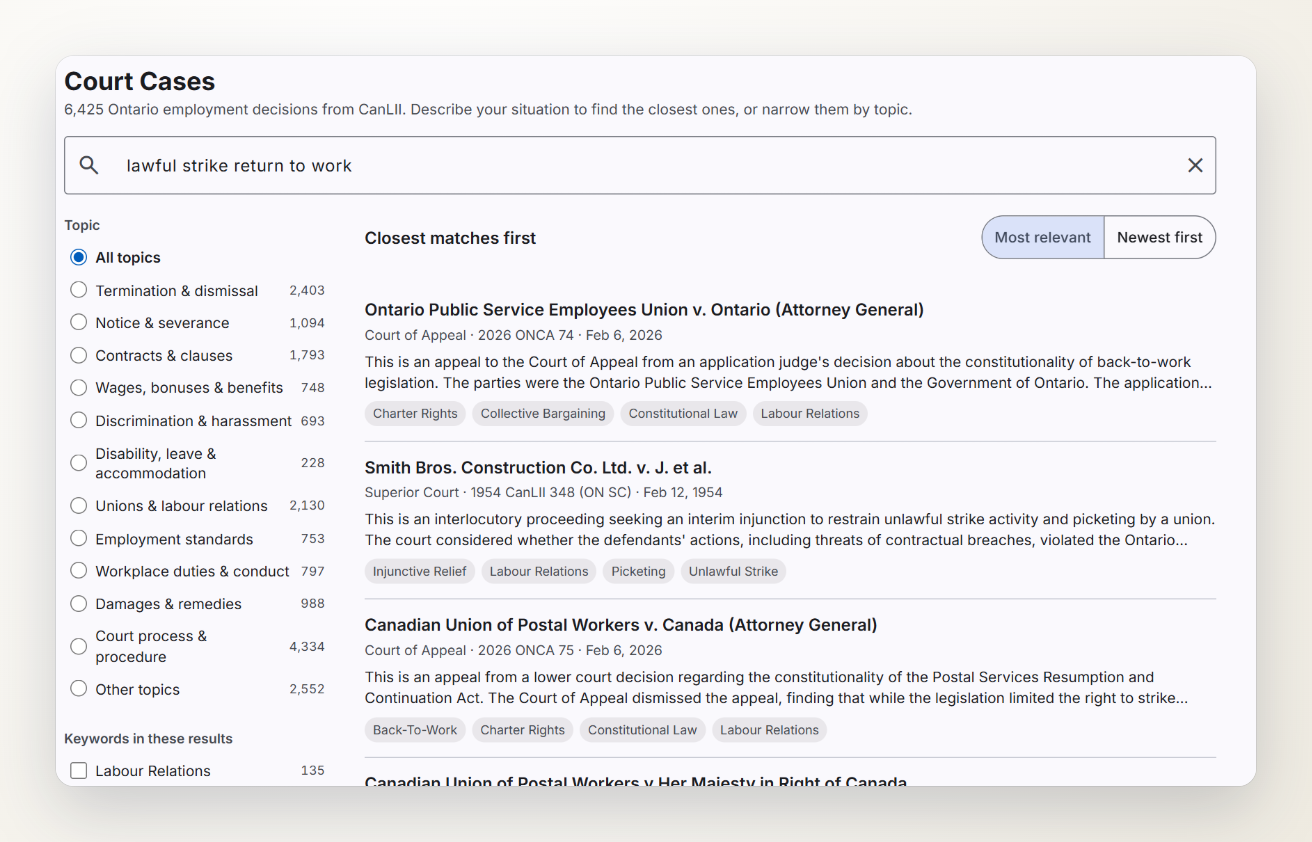
In February 2026, the Court of Appeal for Ontario ruled for the first time on whether back-to-work legislation is constitutional. It found that the 2017 law ending a five-week strike by Ontario college faculty did limit their Charter rights, but that Ontario had justified it: the strike put students' academic term at risk, and the law sent the dispute to binding arbitration by a neutral arbitrator, with no outcome off the table, as the trial judge found and the court upheld (Ontario Public Service Employees Union v. Ontario (Attorney General), 2026 ONCA 74). Quoting its own earlier decision, the court noted that each challenge to back-to-work legislation has to be decided on its own facts.
What to expect
- Early November: the Labour Relations Board's ruling on what is bargained centrally, which the Globe reported is expected then.
- November 4 to 18: the five votes.
- After that: conciliation, a report, the waiting period and five days' notice would all come before any strike.
If you work in a school, your union steward or local is the first place to ask about your bargaining unit. For anything else about your rights at work, our assistant answers with Ontario law and real court decisions, and you can browse court decisions on strikes.
Ontario Severance is an independent site, not a law firm, and this is general information. From a chat or a calculator result, you can ask us for help finding an employment lawyer, and we reply within one business day.
Sources
- The Canadian Press via CP24, "Ontario public high school teachers to hold strike vote amid stalled bargaining", Sept. 25, 2026
- The Globe and Mail, "A look at Ontario's current negotiations with its education unions", Oct. 26, 2026
- NOW Toronto, "Ontario education unions to hold strike votes in November 2026", Sept. 27, 2026
- The Conversation, "5 Ontario education unions hold strike votes as cuts squeeze classrooms", Oct. 29, 2026
- OSSTF/FEESO, "Province-Wide Central Strike Vote November 6–16", Sept. 25, 2026
- CUPE-OSBCU, "2026 Central Bargaining Update #9", Sept. 20, 2026
- AEFO, communiqués (strike vote, Sept. 23, 2026)
- Labour Relations Act, 1995, ss. 79, 80, 80.1 and 81
- School Boards Collective Bargaining Act, 2014, ss. 28 and 34
- Saskatchewan Federation of Labour v. Saskatchewan, 2015 SCC 4
- Ontario Public Service Employees Union v. Ontario (Attorney General), 2026 ONCA 74
This article is general information about Ontario employment law, not legal advice. The law and its application change, and every case turns on its own facts: for advice about your situation, speak with an Ontario employment lawyer.