Court decision
Quit a commission job? You may not owe your draw back
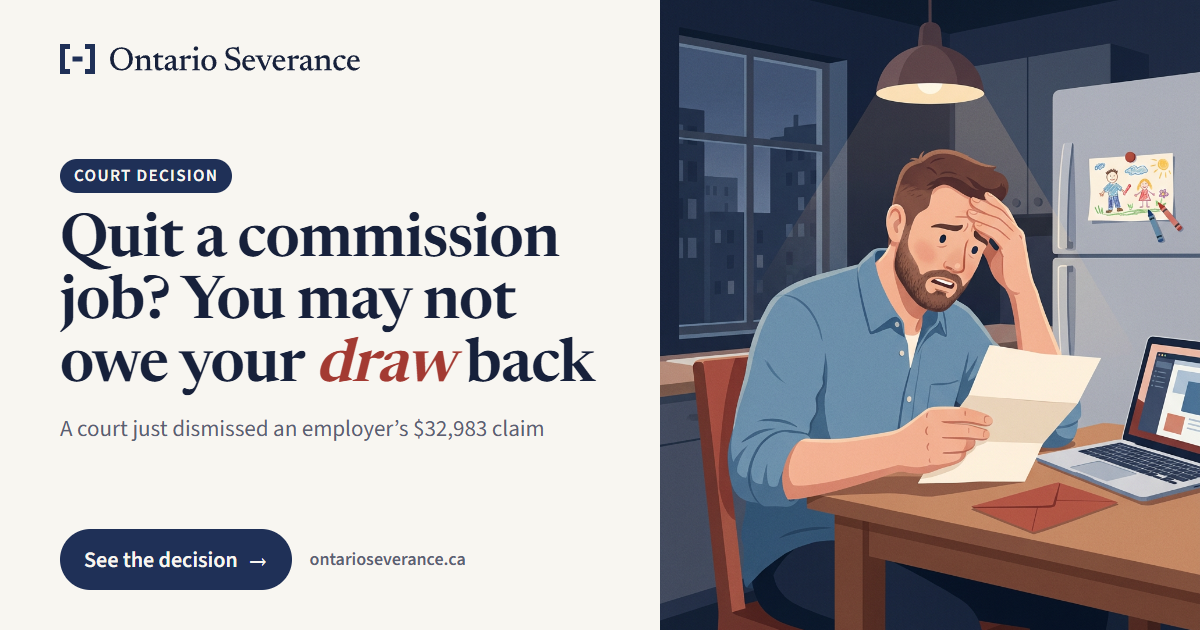
You took a sales job with a "draw against commissions". Sales started slowly, you left, and now your old employer wants the difference back. An Ontario court just looked at exactly that situation, and the employee owed nothing.
What happened
A senior account executive joined an insurance brokerage in 2022. His contract promised "a draw against commissions" of $90,000 a year for his first three years.
He resigned less than six months in, during his probation period. By then he had been paid $42,375 in draws and had earned $9,391.92 in commissions. The employer sued for the $32,983.08 difference, and Small Claims Court ordered him to pay it.

Why the appeal court said no
On August 13, 2026, the Divisional Court set that judgment aside and dismissed the employer's claim (2250898 Ontario Inc. v. P., 2026 ONSC 4676). Three reasons stand out.
- A draw is not automatically a loan. Some draws must be repaid. Others are a guaranteed floor, recovered only from the commissions you earn. What counts is what the contract said when you signed, and the employer who wants the money back has to prove it.
- The contract didn't say so. The employer wrote it. It said the draw was "against commissions" and nothing about repaying from his own pocket. A separate clause on "advances" only let the company deduct them from his final pay. The court refused to add a repayment duty after the fact.
- Minimum wage still applies. The Employment Standards Act says an employer must pay at least the minimum wage, and no contract can waive that. Repaying everything would have left him $9,391.92 for at least 875.5 hours of work, below the $15 an hour that was the minimum at the time.
Before you pay anything back
Read your contract first. If it clearly says draws beyond your commissions must be repaid, the court said that term can be enforced. Even then, it noted, other judgments have limited the repayment so the employee keeps at least minimum wage and vacation pay.
If the contract is silent, this decision is on your side. The court also found this salesperson was an employee, even though he was paid through his own corporation at the employer's suggestion.
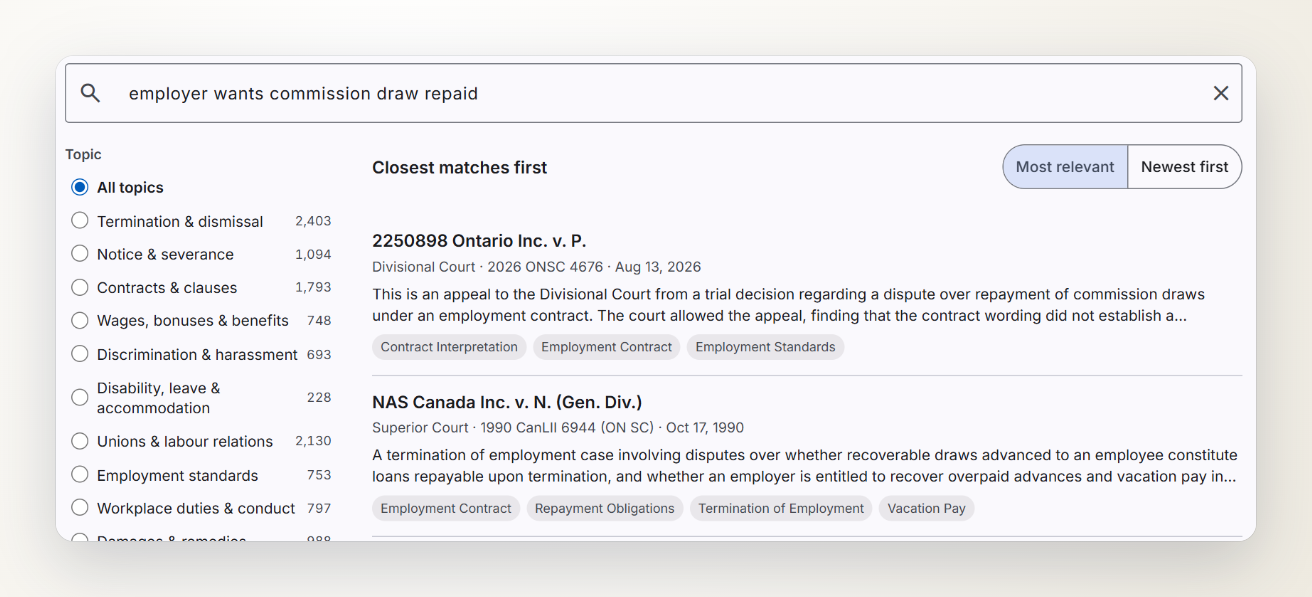
Want to see how other commission disputes ended? Browse the commission decisions →
Ontario Severance is independent and is not a law firm. This is general information. From a chat or a calculator result, you can ask us for help finding an employment lawyer, and we reply within one business day.
Sources
This article is general information about Ontario employment law, not legal advice. The law and its application change, and every case turns on its own facts: for advice about your situation, speak with an Ontario employment lawyer.