Court decision
Remote job for a foreign company? Your case can stay here
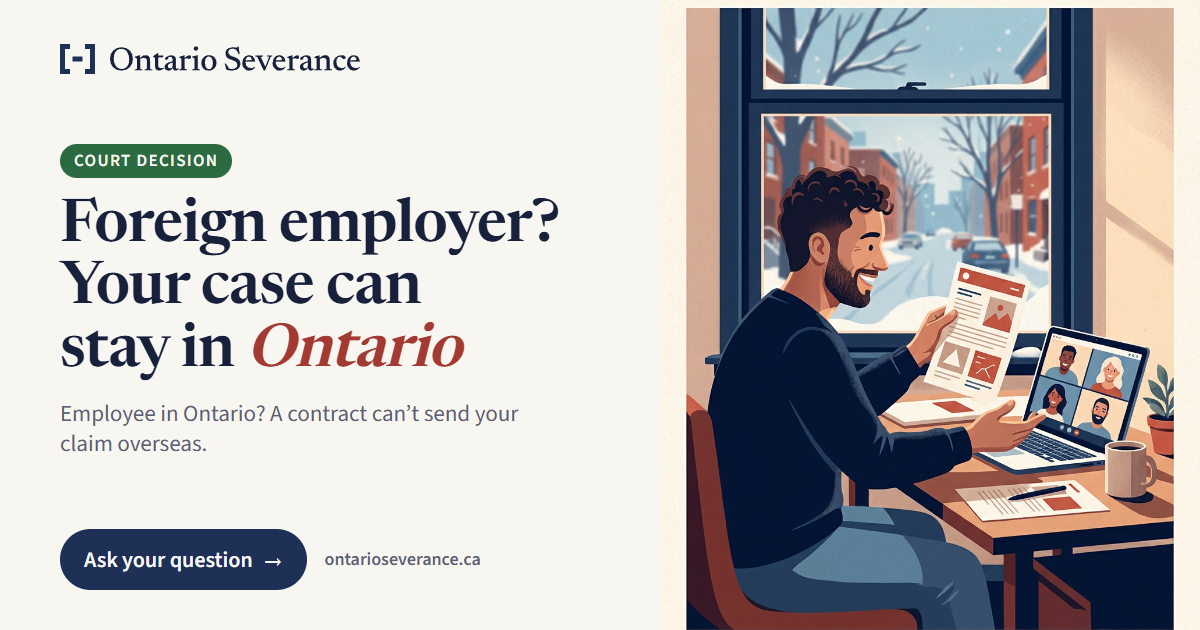
You work from home in Ontario for a company based overseas. Your contract calls you a consultant and says every dispute goes to the courts of England. Then the job ends. In July, Ontario's Court of Appeal voided a clause like that and let the case go ahead here.
What happened
The worker co-founded a fire safety business that became two English companies. In 2021 he signed a three-year contract as their full-time Director of Product Development, paid 80,000 British pounds a year, working from an office in Ottawa. Given the choice, he asked to be a consultant rather than an employee, for tax reasons, and the contract said it was not an employment contract.
In September 2022 the company ended the contract, alleging cause, and he sued in Ontario. Pointing to a clause giving the courts of England and Wales exclusive jurisdiction, the company had the case stopped in 2024: a motion judge found he was an independent contractor.

What the Court of Appeal decided
On July 29, 2026, the court found he was an employee under Ontario's Employment Standards Act, whatever the contract called him. He was required to work full time for the company alone, it could set when and where he worked, it approved his vacation and paid for his laptop, and he had a company email and business cards. Owning shares didn't make him a contractor: employees can own shares too.
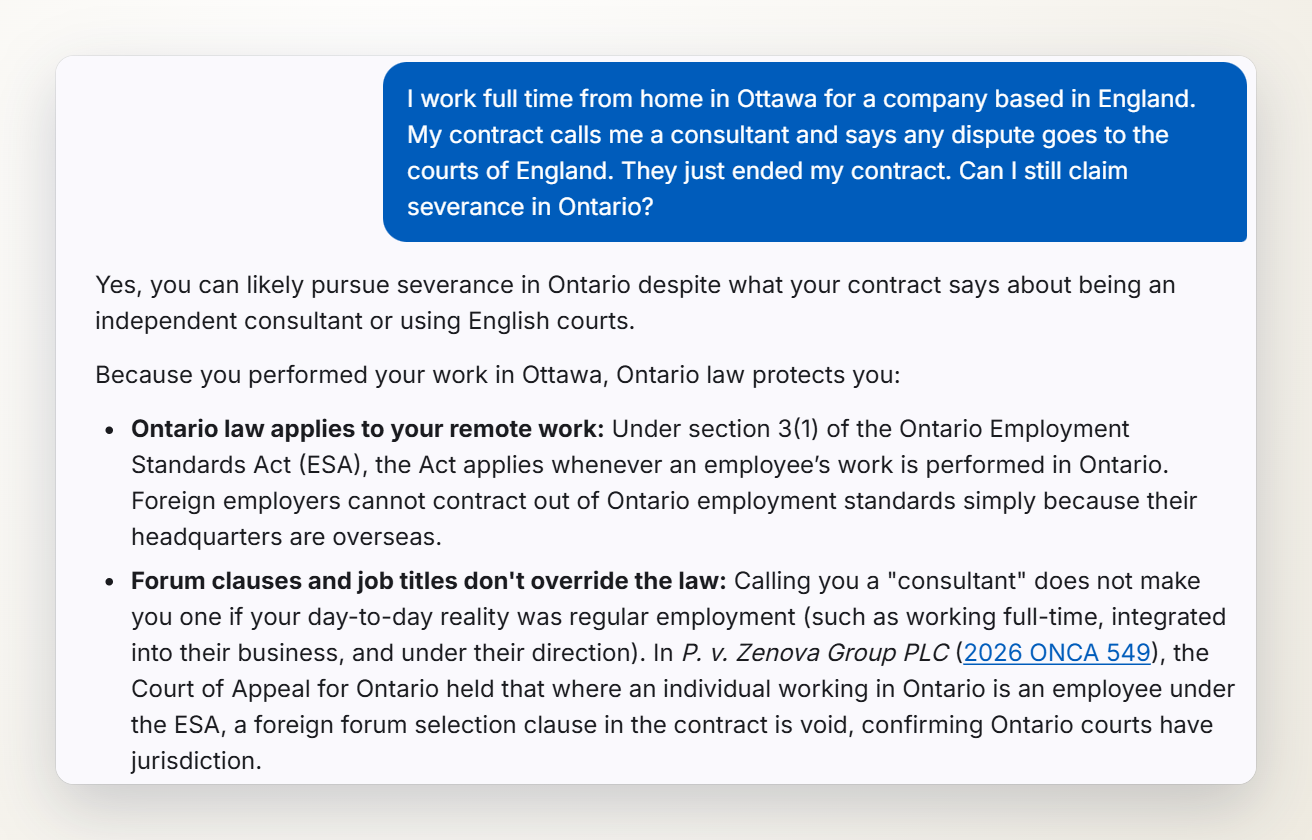
That settled the clause. The Act applies when your work is performed in Ontario (s. 3(1)), and no contract can take away one of its standards (s. 5(1)). Those standards include the right to file a complaint with the Ministry of Labour (s. 96(1)), and a clause sending every dispute abroad takes that right away. Following Heller v. Uber Technologies Inc. (where the clause sent Uber drivers to arbitration in the Netherlands), the court declared it void.
The court also held that Ontario courts can hear the case, because the work was done here and the termination letter was received here, and that England was not clearly a better place for it.
What it means for you
- The label isn't the answer. How you actually work decides your status (more on contractors on paper).
- Where you work counts. If you're an employee and your work is performed in Ontario (or partly outside Ontario as a continuation of that work), the Act applies, wherever your employer is based, unless your job falls under federal law (s. 3).
- This is not the end of the story. The court decided where the case is heard, not whether the company had cause or what the worker is owed. That comes next.
Job over and employer abroad? Start with what the law gives you here.
Read the decision's summary →
Ontario Severance is independent and not a law firm; this is general information. From a chat or a calculator result, you can ask us for help finding an employment lawyer, and we reply within one business day.
Sources
This article is general information about Ontario employment law, not legal advice. The law and its application change, and every case turns on its own facts: for advice about your situation, speak with an Ontario employment lawyer.