Court decision
Recalled after a layoff? Going back may not end your claim
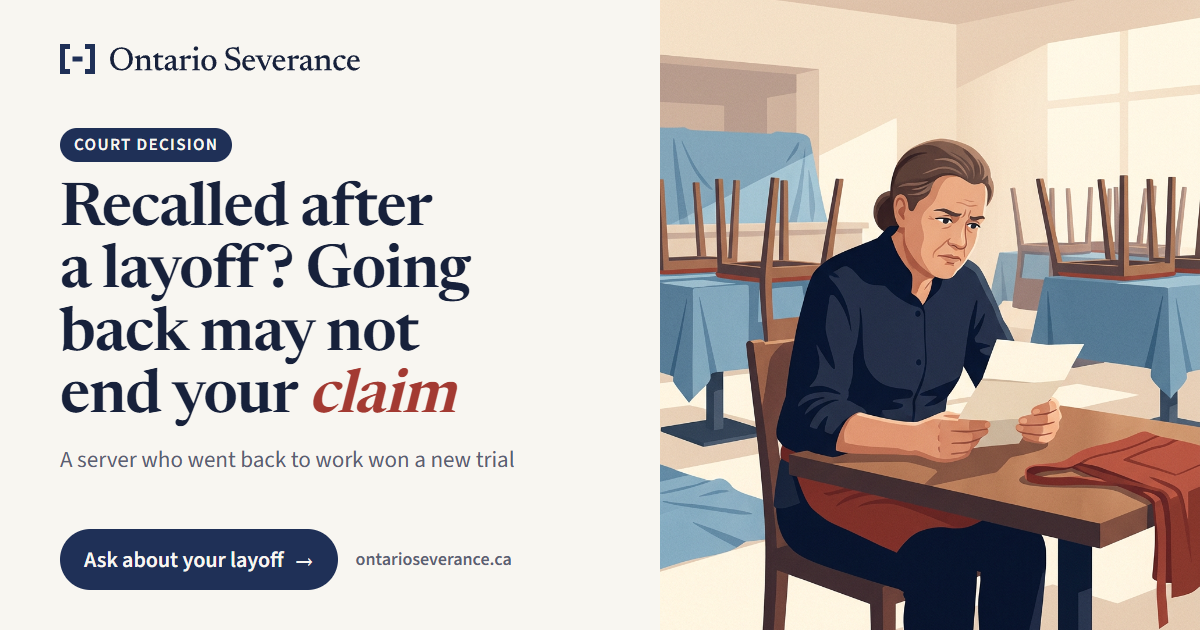
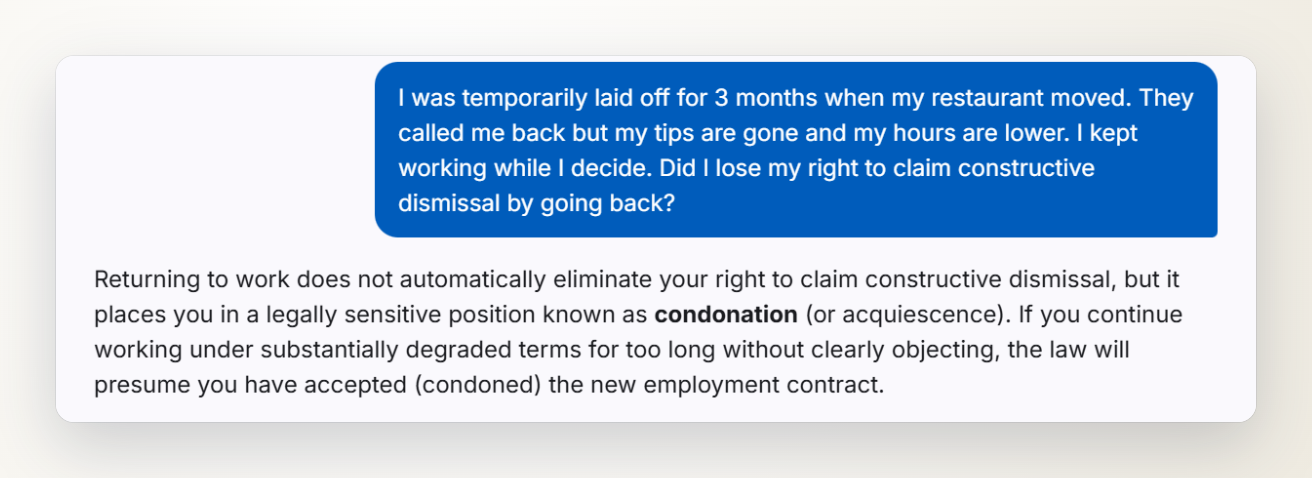
You were laid off without agreeing to it, then called back to a job that pays less. You need the income, so you kept working. Did you give up your claim? A July 2026 Divisional Court decision says not necessarily.
What happened
A senior server had worked at a Toronto restaurant since 2015, about 35 hours a week, earning an hourly wage plus tips. In March 2023 the employer laid off its staff while the restaurant moved, with a letter asking employees to sign that they agreed. He didn't sign.
From June 12, 2023, the employer paid him an hourly wage again, but the restaurant didn't reopen until July 28, so there were no tips. On June 20, his lawyer wrote to the employer that the layoff was a constructive dismissal, meaning the employer had broken the contract badly enough to end it. He kept working there and sued in December 2023.
The Small Claims Court dismissed his claim. The judge found that by accepting wages and going back to work, he had condoned the layoff, that is, accepted it.

What the appeal court said
The Divisional Court allowed his appeal on July 28, 2026 and ordered a new trial. It found several errors of law:
- Silence isn't acceptance. Accepting a change takes positive action, and the employer must prove it. Saying nothing during the layoff, after refusing to sign, was not condonation.
- Being paid isn't being back. The wages from June 12 came with no shifts and no tips, presumably paid, the court said, to avoid the Employment Standards Act's rule that a layoff over 13 weeks in 20 can become a termination.
- You get time to see the new terms. It was unclear when the restaurant would reopen.
- A clear letter is enough. You don't need to sue to take a firm position; telling the employer clearly does it.
- Staying can be mitigation. Once the employer knew his position and let him keep working, staying on could count as reducing his losses. That only counts if his claim succeeds, and only for the notice period he is owed.
The court didn't decide whether he was dismissed or what he is owed: that is for the new trial. It also repeated that, in most cases, working under changed terms for a significant period will be seen as accepting them.
What this means for you
Unless your contract allows it, a layoff can itself be a constructive dismissal, the court noted. If you were laid off or called back to worse terms:
- Don't sign anything saying you agree to the change unless you do.
- Object in writing, and keep a copy.
- Get advice early: the time to decide is reasonable, not unlimited.
Read the decision's summary or more cases on temporary layoffs. What notice could you be owed? Run the severance calculator →
Ontario Severance is independent and not a law firm; this is general information. From a chat or a calculator result, you can ask us for help finding an employment lawyer, and we reply within one business day.
Sources
This article is general information about Ontario employment law, not legal advice. The law and its application change, and every case turns on its own facts: for advice about your situation, speak with an Ontario employment lawyer.