Know your rights
A month per year of service? Courts say there's no such rule

A co-worker, your brother-in-law, maybe even your employer has told you: severance is "a month per year of service". It's easy to count on your fingers. It's also not the law in Ontario, and counting that way can leave you expecting far too little, or too much.
The court that said no
In Minott v. O'Shanter Development Company Ltd. (1999), a trial judge started from one month per year for a maintenance worker with 11 years of service, then adjusted to 13 months.
The Court of Appeal for Ontario kept the 13 months as within a reasonable range, but rejected the method. The rule of thumb, it said, "is not warranted in principle, nor is it supported by authority". It puts too much weight on one factor, your years of service, at the expense of the others.
What courts weigh instead
Reasonable notice (the pay courts award in place of notice when you're let go without cause) is decided case by case. Courts weigh four things together, known as the Bardal factors:
- the kind of job you had,
- how long you worked there,
- your age,
- how hard it will be to find similar work, given your experience and training.

Two decisions the "rule" gets wrong
Short service, long notice. In Love v. Acuity Investment Management Inc. (2011), a 50-year-old senior vice-president had 2.53 years of service. The trial judge gave 5 months. The Court of Appeal raised it to 9, because the trial decision overemphasized his short service and underplayed how senior the job was.
Long service, fewer months than years. In Di Tomaso v. Crown Metal Packaging Canada LP (2011), a 62-year-old mechanic with over 33 years of service was awarded 22 months, upheld on appeal. The employer had argued for 12 at most because he wasn't a manager. The court refused that cap too.
What this means for you
If an offer was built on "a month per year", or a few weeks per year, that's a formula someone chose. A court wouldn't start there. A termination clause in your contract can limit what you're owed, so read it before you compare.
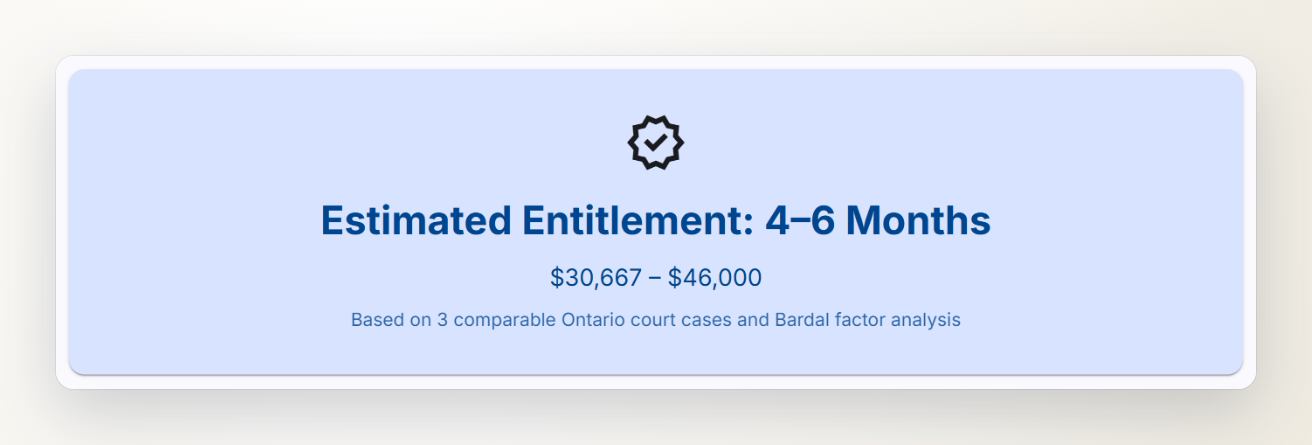
Our calculator doesn't use a per-year formula either. It compares your age, role and service with what Ontario courts awarded in similar cases.
Have a question about your own case? Ask it here →
Ontario Severance is independent and isn't a law firm; this is general information. From a chat or a calculator result, you can ask us for help finding an employment lawyer, and we reply within one business day.
Sources
This article is general information about Ontario employment law, not legal advice. The law and its application change, and every case turns on its own facts: for advice about your situation, speak with an Ontario employment lawyer.