Know your rights
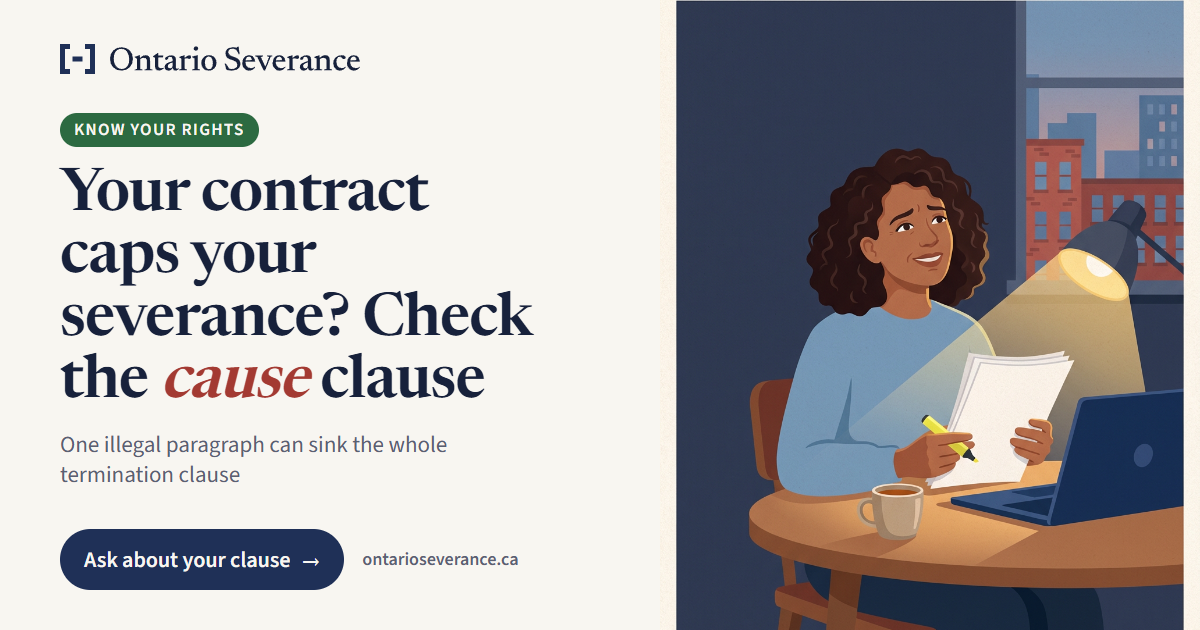
Your contract caps your severance? Check the cause clause
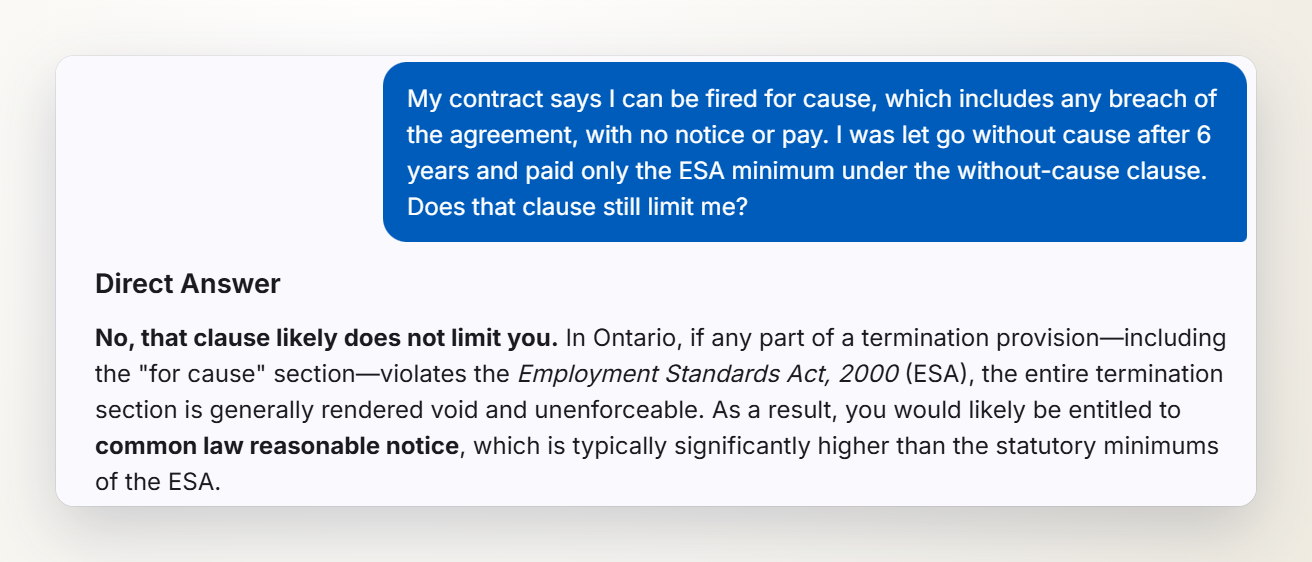
You were let go without cause, and your employer paid only the legal minimum because your contract says so. Before you accept that, read a different paragraph: the one about firing for cause. Ontario's Court of Appeal has struck down whole termination clauses because of it.
One bad paragraph sinks them all
In Waksdale v. Swegon North America Inc., 2020 ONCA 391, a director of sales was let go without cause after about nine months and paid two weeks. His employer admitted its for-cause paragraph broke the Employment Standards Act (ESA), but said the separate without-cause paragraph was fine.
The court said no. Termination provisions are read as a whole: if one breaks the ESA, none can be enforced, even if the employer never relied on the illegal part.
What makes a cause clause illegal
The ESA lets an employer skip notice and termination pay only for "wilful misconduct, disobedience or wilful neglect of duty that is not trivial and has not been condoned by the employer" (the Ministry's guide). The Court of Appeal has called this a higher bar than "just cause" at common law (Render v. ThyssenKrupp Elevator, 2022 ONCA 310). A contract that lets the employer pay nothing for less fails the ESA.
Two recent appeals show the wording that does it:
- "Failure to perform the services", in a definition of cause that "shall include but is not limited to" its examples. In Dufault v. Ignace (Township), 2024 ONCA 915, the cause clause failed and took the without-cause clause down with it, and the employee kept the $157,071.57 the motion judge had ordered, pay for the rest of her fixed-term contract.
- "Breach of Employment Agreement", with nothing requiring the breach to be wilful or serious. In D.C. v. Arista Homes Limited, 2025 ONCA 260, an employee of four years and nine months had been paid four weeks' salary. The court upheld the 8 months' salary she was awarded instead.
That employer said its contract plainly meant to follow the law. The court said the words must comply, whatever the intent.

Not every clause falls
Courts judge the words as signed, not what your employer paid later. And some clauses hold: in August, the same court upheld two that promised the ESA minimum throughout. One even defined cause more broadly than the ESA, and held because it still promised the ESA minimum after a firing for cause (our article). What sinks a clause is cutting you below the ESA minimum, not a broad definition alone.
What to do
- Find every paragraph about ending your job, including the one on cause and any definition of it.
- Look for words like "includes but is not limited to", "any breach" or "failure to perform".
- Don't sign a release before you know whether your clause holds: with it, you may be owed weeks; without it, reasonable notice, the pay courts award in place of notice, can run to months, as it did in the cases above.
See court decisions on termination clauses →
The calculator shows your ESA minimum beside what courts have awarded in cases like yours. Or paste your clause into the chat and ask.
Ontario Severance is independent and isn't a law firm; this is general information. From a chat or a calculator result, you can ask us for help finding an employment lawyer, and we reply within one business day.
Sources
- Waksdale v. Swegon North America Inc., 2020 ONCA 391 (Court of Appeal for Ontario)
- Dufault v. Ignace (Township), 2024 ONCA 915 (Court of Appeal for Ontario)
- D.C. v. Arista Homes Limited, 2025 ONCA 260 (Court of Appeal for Ontario)
- Render v. ThyssenKrupp Elevator (Canada) Limited, 2022 ONCA 310 (Court of Appeal for Ontario)
- Your guide to the Employment Standards Act: Termination of employment (Ontario Ministry of Labour)
This article is general information about Ontario employment law, not legal advice. The law and its application change, and every case turns on its own facts: for advice about your situation, speak with an Ontario employment lawyer.