Know your rights
Stellantis strike vote: what it means for workers
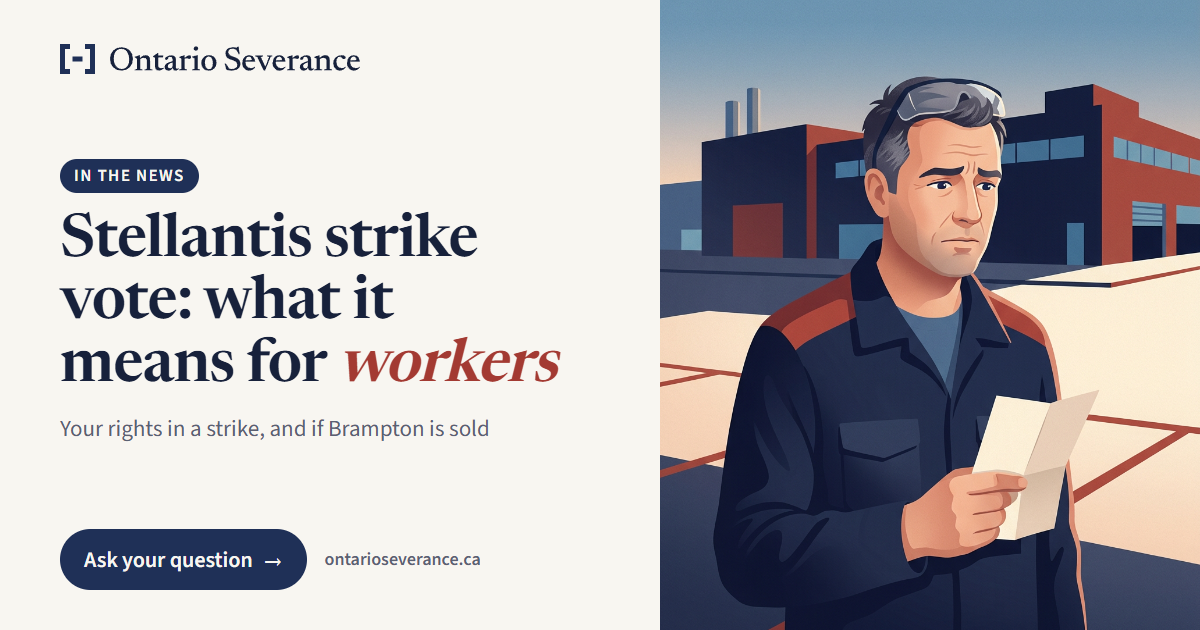
Unifor members at Stellantis, about 9,000 workers in Canada, vote this Saturday and Sunday on whether to give their bargaining committee the right to call a strike. A yes vote doesn't start one. Here is what has changed since our guide to the Windsor layoffs, what Ontario law says happens next, and what it means if the Brampton plant is sold.
What's new
- September 11: Unifor walked away from the table after Stellantis confirmed a preliminary agreement, a memorandum of understanding, to sell the idled Brampton Assembly Plant to Roshel, a maker of armoured vehicles (The Globe and Mail). Stellantis calls it a path to restoring sustainable operations there.
- September 20: the collective agreement expired. In its September 24 update, Unifor said the parties were in conciliation, the terms of the old agreement still applied, and it was not in a legal strike position. It says Stellantis made the settlement for Windsor, Etobicoke, Mississauga and Red Deer conditional on an agreement to close and sell Brampton, which the union rejects.
- October 6: Unifor announced strike authorization votes for October 17 and 18, with results on October 19 (The Globe and Mail, CTV News). Stellantis told CTV News it remains committed to bargaining in good faith.
The Globe and Mail reports that about 2,200 Brampton workers remain on layoff, and that the federal government has said a sale would breach a funding agreement under which Stellantis received public money to retool the plant.

What a yes vote does, and when a strike could start
Ontario's Labour Relations Act sets the steps:
- The vote. It is a secret ballot, every employee in the bargaining unit can vote, member or not, and a strike needs more than half of those voting (s. 79(3), (7) and (8)).
- The timing. With no agreement in force, no strike or lockout is legal until a conciliation officer has been appointed and 16 days have passed after the Minister releases a "no board" notice (s. 79(2)). We found no report of such a notice yet.
- The freeze. Until 14 days after that notice, the company can't change wages or other terms without the union's consent (s. 86(1)).
Your rights if a strike comes
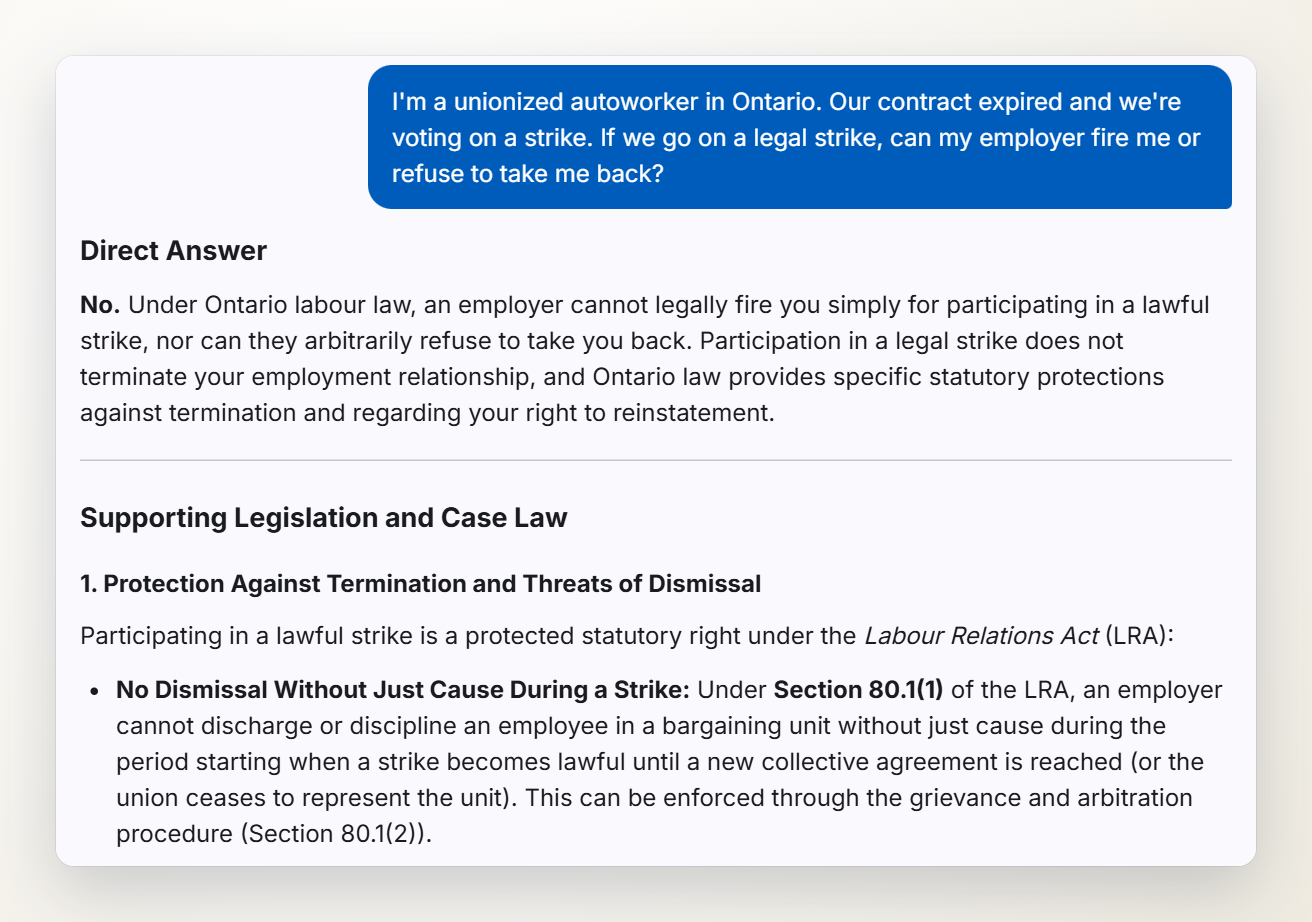
- No firing for striking. From the day a strike becomes lawful until a new agreement, the employer can't discharge or discipline anyone in the unit without just cause (s. 80.1).
- Your job back. A striker who applies in writing, without conditions, to return to work within six months of the start of a lawful strike must be reinstated, unless that work no longer exists or operations were shut down for cause (s. 80).
- Your layoff count. Under the Employment Standards Act, a week off because of a strike or lockout is an "excluded week": it isn't counted as a week of layoff, though it stays inside the 20- or 52-week window (ESA s. 56(3) to (3.2)).
- Employment Insurance. The federal government says you may not be eligible if you're out of work because you're directly taking part in a labour dispute. Ask your local about strike pay.
If the Brampton plant is sold
No sale has closed, and the union opposes it. If one does, two rules decide what carries over:
- The union and the agreement. When an employer bound by a collective agreement sells its business, or part of it, the buyer is bound by that agreement until the Ontario Labour Relations Board declares otherwise (Labour Relations Act, s. 69(2)). The Board decides whether what changed hands is a "business" or only a building, and it can end the union's rights within 60 days if the buyer's business is substantially different (s. 69(5)).
- Your service. If the buyer hires a seller's employee within 13 weeks, the job is not ended for ESA purposes and the years of service carry over (ESA s. 9).
- If jobs end instead. When 50 or more employees are terminated at one establishment within four weeks, the employer must give longer notice and file a notice with the Director of Employment Standards (ESA s. 58).
Our Stelco guide explains the choice between severance pay and recall rights when a long layoff becomes a termination.
What to watch
- October 17 and 18: the vote. October 19: the results.
- A "no board" notice from the Minister of Labour: a legal strike could begin on the 17th day after it.
- Your steward first. In a union, rights under the Employment Standards Act are enforced through the agreement and a grievance (ESA s. 99).
Working at a non-union supplier and facing layoffs because the line is down? Courts can award more than the ESA minimum. The calculator shows both.
More: court decisions involving unions →
Ontario Severance is independent and isn't a law firm; this is general information. From a chat or a calculator result, you can ask us for help finding an employment lawyer, and we reply within one business day.
Sources
- The Globe and Mail: Canadian Stellantis workers to hold strike vote as auto talks stall, union says (Oct. 6, 2026)
- CTV News Windsor / AM800 CKLW on CP24: Unifor to hold strike authorization votes as Stellantis talks remain stalled (Oct. 6, 2026)
- Unifor Auto Talks 2026: Update on Unifor-Stellantis negotiations (Sept. 24, 2026)
- Labour Relations Act, 1995, ss. 69, 79, 80, 80.1 and 86
- Employment Standards Act, 2000, ss. 9, 56, 58 and 99
- Government of Canada: EI regular benefits, eligibility
This article is general information about Ontario employment law, not legal advice. The law and its application change, and every case turns on its own facts: for advice about your situation, speak with an Ontario employment lawyer.