Court decision
Your contract may cap your severance: a court just said so
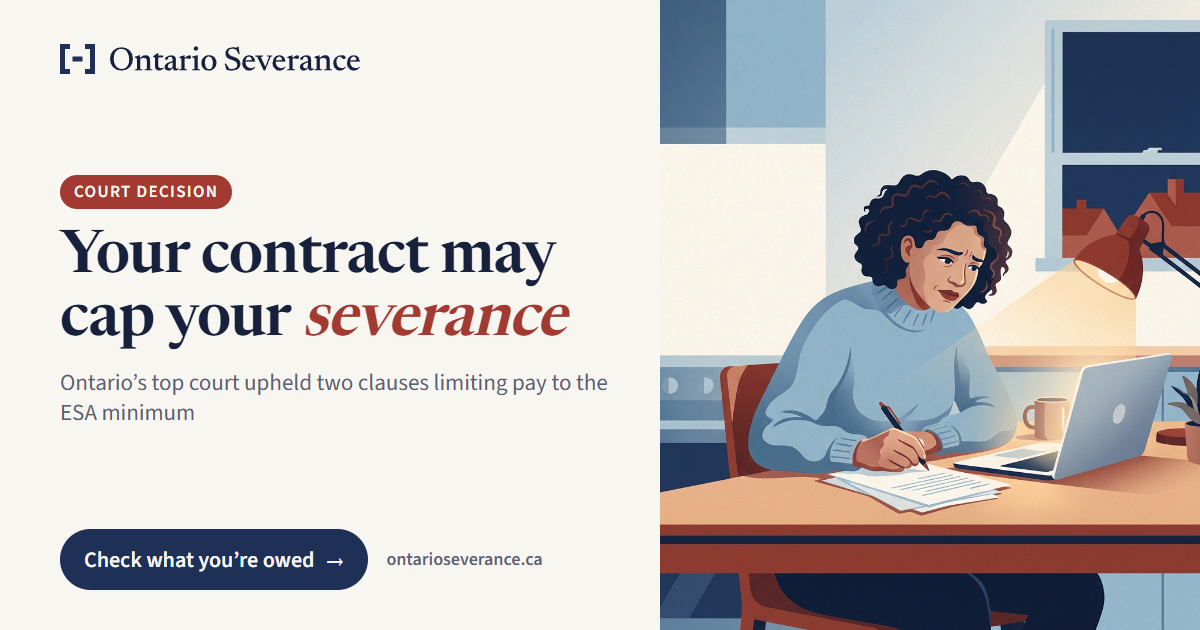
Your contract says your employer can let you go "at any time" with only the legal minimum. In August, the Court of Appeal for Ontario said that wording can hold, and two employees ended up with one and two weeks of pay.
What the court decided
In Baker v. Van Dolder's Home Team Inc., 2026 ONCA 568, the court decided two appeals. A finance head with just over two years of service and a senior product manager with under a year had nearly identical clauses: the employer could end the job without cause "at any time" (and in the second contract, "for any reason"), paying only what the Employment Standards Act (ESA) requires.
A lower court had struck the first clause down, saying "at any time" could allow a firing the ESA forbids. The Court of Appeal upheld both.

Why the clauses held
The court read each contract as a whole. Both promised, again and again, at least the ESA minimum. Read that way, "at any time" only means a dismissal is valid whenever it happens, and "for any reason" means the employer doesn't have to give one. Neither lets an employer break the ESA, which says no one can contract out of its standards (s. 5).
The first contract also defined "cause" more broadly than the ESA's "wilful misconduct", but still promised the ESA minimum after a firing for cause, so it held too. Clauses that take away ESA pay for lesser misconduct remain void.
What it cost
With the clauses enforceable, both employees were limited to the ESA minimum instead of reasonable notice, the pay courts award in place of notice. Under s. 57, that meant one week for under a year of service and two weeks for one to three years. The first had turned down four weeks offered for signing a release. The court noted this might be thought harsh, but said whether the ESA minimums are enough is for the legislature to decide.
What to take from it
- Find your clause. Whether it holds can decide whether you get weeks or months.
- Words like "at any time" won't sink it by themselves. Courts look at what the whole contract promises.
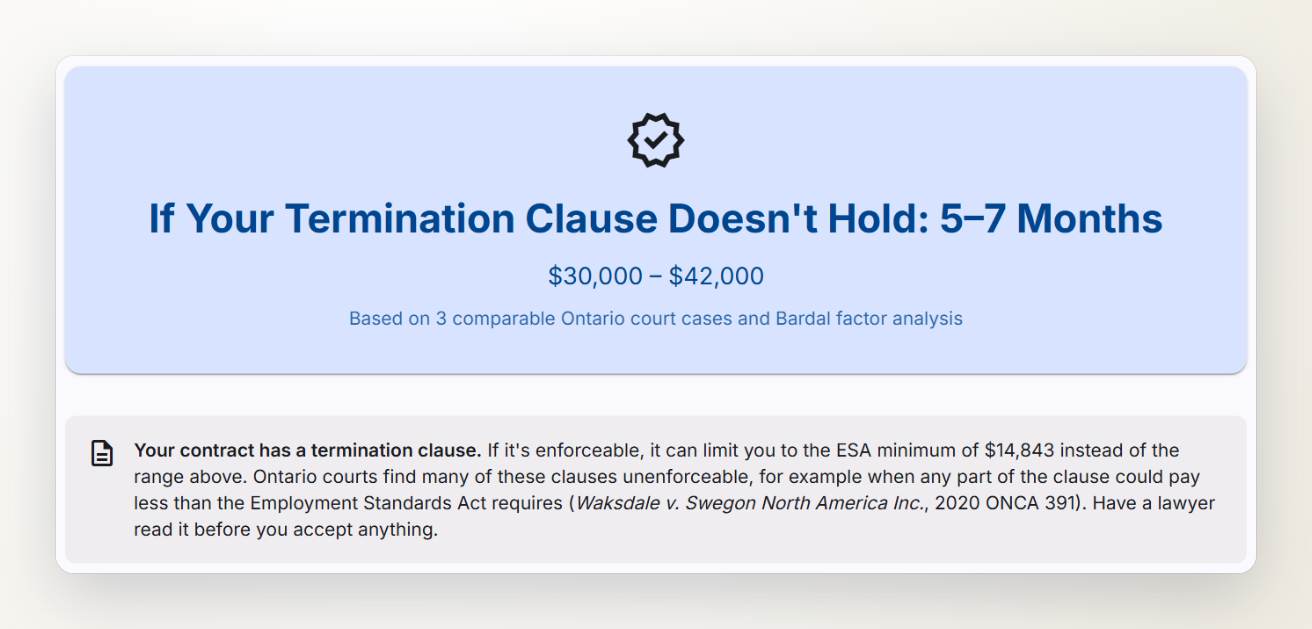
- Every clause is different. Under the court's earlier Waksdale ruling, if one termination provision breaks the ESA, they all fall. See court decisions on termination clauses →
See both numbers for your job
The calculator shows your ESA minimum next to what courts have awarded in cases like yours. Or paste your clause into the chat and ask about it.
Ontario Severance is independent and isn't a law firm; this is general information. From a chat or a calculator result, you can ask us for help finding an employment lawyer, and we reply within one business day.
Sources
This article is general information about Ontario employment law, not legal advice. The law and its application change, and every case turns on its own facts: for advice about your situation, speak with an Ontario employment lawyer.