Court decision
Fired before your stock vested? A court says it counts

Let go before your stock units vested, and your contract says you lose them? In August, the Court of Appeal for Ontario ruled that a clause like that broke the Employment Standards Act. It added the units that would have vested over the employee's notice period to his damages.
What happened
In Wigdor v. Facebook Canada Ltd., 2026 ONCA 572, a research director was let go without cause in December 2023. Part of his pay came as restricted stock units (RSUs): company shares handed over on a set schedule, as long as you're still employed.
His RSU agreements said unvested units were forfeited on termination, and that no vesting would continue during any notice period.
The courts first found his termination clause void. It allowed two weeks' notice in his first three months, but under the ESA his nine years at the company sold to his employer's group counted from day one. So he was owed reasonable notice, the pay courts award in place of notice: 10 months. On appeal, the court added the value of the units that would have vested in those 10 months, US$4,711,647.29.

Why the clause failed
During the ESA notice period, section 60 says an employer can't cut your wage rate or "alter any other term or condition of employment." Section 61 says pay in lieu of notice must equal what you'd have received under section 60.
Read together, the court said, pay in lieu is calculated as if nothing about your job changed. Cutting off vesting on your last day changes a term, so the clause is void under section 5, and a void clause can't take away your right to reasonable notice, including what would have vested.
What to take from it
- The wording counts, not what your employer did. A clause is judged as written when you signed it, even if you were later paid your ESA minimums.
- Vague saving words may not rescue it. "Unless explicitly required by applicable legislation" didn't save these agreements.
- Having a lawyer when you signed doesn't lower the bar. The court rejected that argument.
- Every plan is different. The court left open whether stock awards are "wages" under the ESA, and your notice period depends on your own facts.
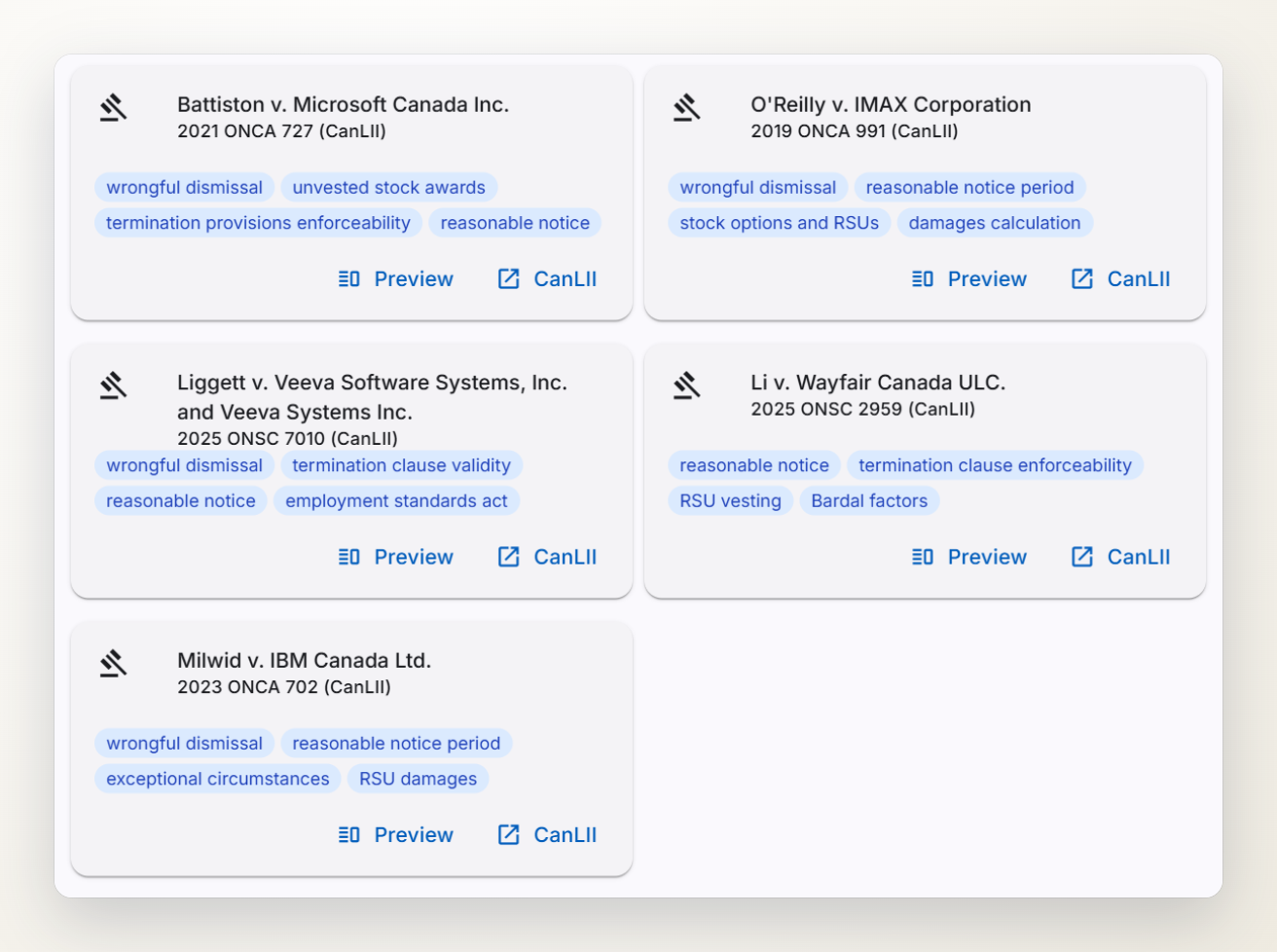
More on clauses like these: court decisions on termination clauses →
Check your own situation
Tell the chat what your contract and stock plan say, or run the calculator to see your ESA minimum next to what courts have awarded in cases like yours.
Ontario Severance is independent and isn't a law firm; this is general information. From a chat or a calculator result, you can ask us for help finding an employment lawyer, and we reply within one business day.
Sources
This article is general information about Ontario employment law, not legal advice. The law and its application change, and every case turns on its own facts: for advice about your situation, speak with an Ontario employment lawyer.