Law change
Paying for your work uniform? Ontario plans to stop it
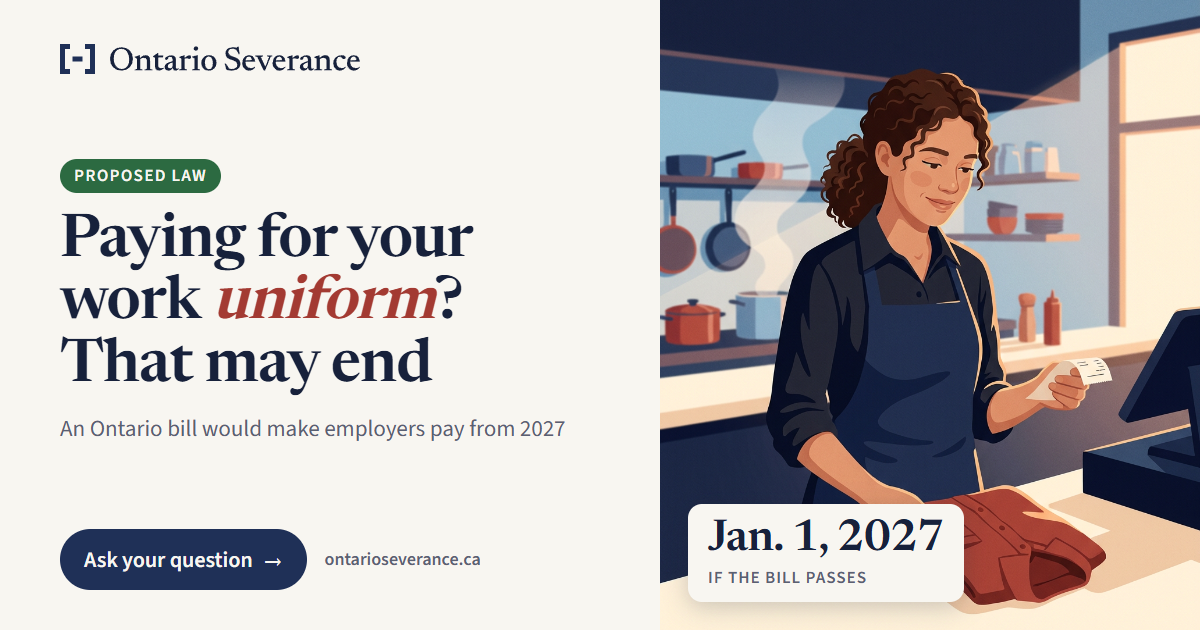
Bought your own logo shirt to start a new job? Watched the cost come off your pay? A bill now waiting for its final vote at Queen's Park would make that your employer's cost, starting January 1, 2027. And even today, your employer can't simply take it off your pay.
What the bill would change
Bill 105, the Protecting Ontario's Workers and Economic Resilience Act, 2026, adds a new section 13.1 to the Employment Standards Act. An employer could not, directly or indirectly, make you pay for a uniform you must wear at work. A "uniform" means clothing unique to or identified with the employer's business, such as clothing with its name, logo or brand.
It also covers repairs and laundering: if your employer cleans or fixes the uniform, or has someone else do it, it can't make you pay for that either.
There are exceptions. You could still be charged for the uniform if you lose it, damage it beyond normal wear and tear, or don't return it when you leave after agreeing to. For repairs or cleaning, only damage beyond normal wear and tear counts. The government can add other items and other exceptions by regulation.
Once the rule starts, signing a deduction authorization wouldn't make a uniform charge allowed either. Money charged against the rule would be owed back to you as wages, and you could claim it under the Act like unpaid pay.

Where the bill stands
- April 14, 2026: the government announced the plan, saying some uniforms cost upwards of $50 and that seven other Canadian jurisdictions already limit or ban the practice, including British Columbia, Quebec and Manitoba.
- April 20, 2026: the bill was introduced.
- May 25, 2026: a committee of the Legislature sent the bill back with amendments, none to the uniform rule, and it was ordered for third reading.
- October 27, 2026: the Legislature returns, and Bill 105's third reading is on its order paper.
It isn't law yet. It needs a third reading vote and Royal Assent, and the uniform rule itself would start January 1, 2027. The government's announcement spoke of large companies and said it would consult on exemptions, such as for small businesses. The bill itself sets no size limit, but exemptions could come by regulation, so not every workplace may be covered.
In a unionized workplace, a collective agreement in force on that date that deals with these charges would win where it conflicts, even after it expires, until a new or renewed agreement takes effect.
What the law says today
Section 13 of the Act already limits what comes off your pay. Outside deductions a law or a court order authorizes, such as taxes, your employer needs your written authorization, and it must name a specific amount or a formula to work it out. Even with your signature, your employer can't take money off your pay for faulty work, or for lost or stolen cash or property that others also had access to.
So if a uniform charge was taken from your pay and you never signed anything, ask about it now. Keep your pay stubs and any receipts.
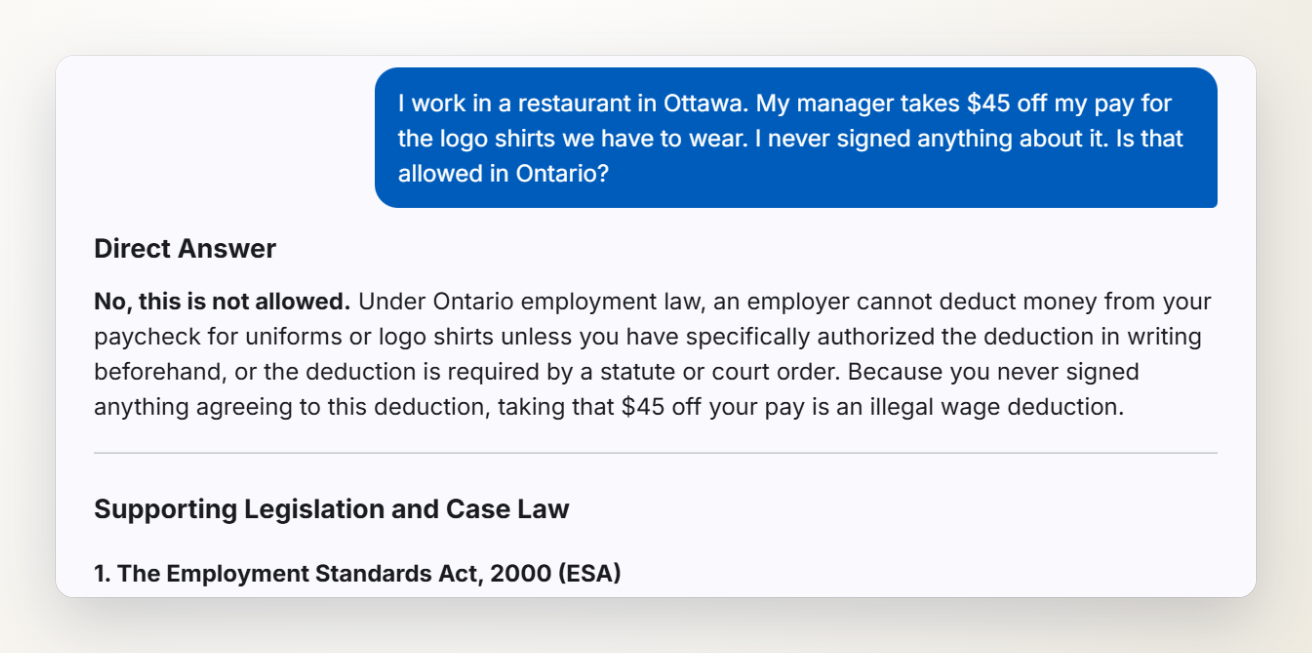
Not sure what your employer can take off your pay, or whether you're owed money? Ask our chat in your own words, or read Ontario decisions on unpaid wages.
Ontario Severance is independent and isn't a law firm: this is general information. From a chat or a calculator result, you can ask us for help finding an employment lawyer, and we reply within one business day.
Sources
- Bill 105, Protecting Ontario's Workers and Economic Resilience Act, 2026 (text and status)
- Ontario Protecting Workers' Paycheques by Banning Uniform Charges at Large Companies, Ontario news release, April 14, 2026
- Employment Standards Act, 2000, s. 13
- Ontario proposes ban on requiring workers to pay for uniforms, The Canadian Press (CP24), April 14, 2026
- Orders and Notices, Legislative Assembly of Ontario, October 27, 2026 (Bill 105, third reading)
This article is general information about Ontario employment law, not legal advice. The law and its application change, and every case turns on its own facts: for advice about your situation, speak with an Ontario employment lawyer.