Know your rights
Stelco layoffs: a forced sale? What it means for workers
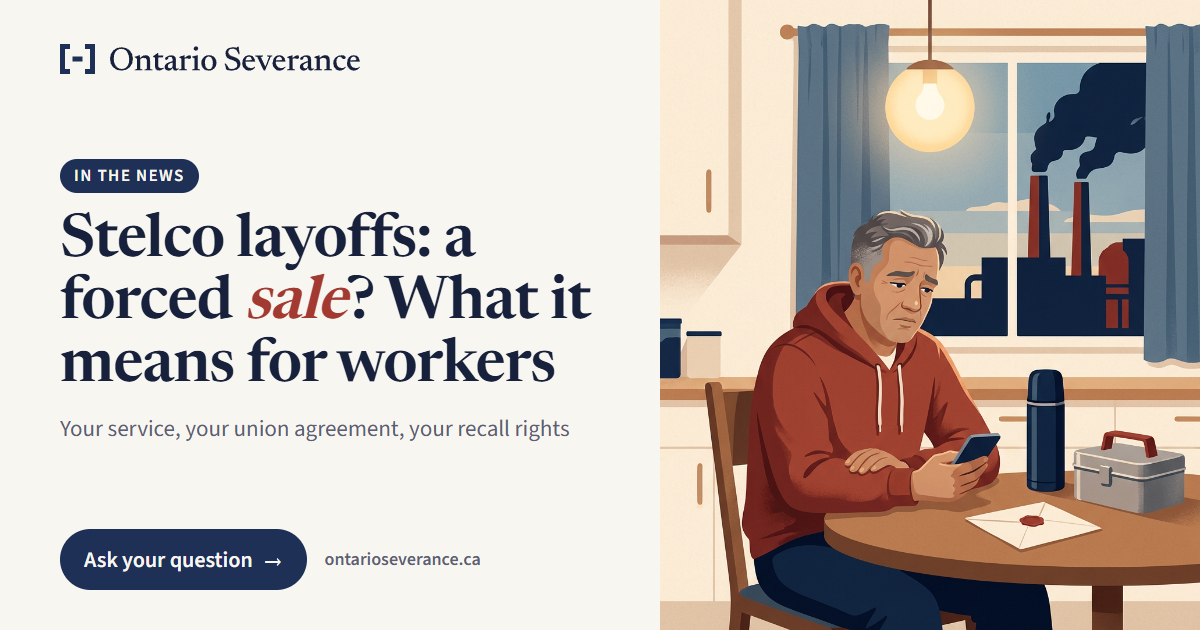
The fight over the Stelco layoffs has a new word in it: sale. Ottawa says a court could order the U.S. owner to sell its Canadian assets, and the owner says it is ready to go to court. Here is what that would mean for the people laid off in Hamilton and Nanticoke.
What happened since our first article
- October 11: In an interview on CBC's Rosemary Barton Live, Cleveland-Cliffs CEO Lourenco Goncalves said the company is prepared to defend the layoffs in court, that the workers can be recalled if Canada and the U.S. reach a trade arrangement, and that he would consider a good offer for Stelco (The Canadian Press, via ScrapMonster; Buffalo Toronto Public Media).
- October 14: Industry Minister Mélanie Joly said a court process under the Investment Canada Act could lead to financial penalties, an order to keep the commitments, or a forced sale of the Canadian assets (The Globe and Mail, Global News). No case had been filed when this was written.
- October 19: On the earnings call, he said Stelco is "finally profitable" (Industrial Info Resources), with its strongest quarter since the 2024 purchase. Union leaders put the layoffs at 333 in Hamilton and up to 50 at Lake Erie Works. Mr. Goncalves said Stelco could bring all the laid-off workers back right away if Ottawa blocks or sharply cuts galvanized steel imports, and called the layoffs a temporary measure until Canada and the U.S. reach a trade agreement (CBC News).
For the background, the union agreements and the 35-week rule, see our guide to the Stelco layoffs.

If the mill is sold, your years go with it
Under the Investment Canada Act, if the owner doesn't comply with a formal demand from the minister (s. 39), a court can, on the minister's application, order it to keep its commitments, sell control of the Canadian business, or pay a penalty of up to $10,000 a day (s. 40). What a sale would mean for workers is already in Ontario law.
If a buyer took over Stelco's shares, your employer would stay the same company, and your job, your service and your union agreement would not change. If the mills or the business itself were sold instead, two rules apply.
Your service carries over. When a business or part of it is sold and the buyer employs you, your employment is not treated as ended under the Employment Standards Act, and your years with the seller count as years with the buyer (s. 9). It applies only if the buyer hires you within 13 weeks of the earlier of your last day with the seller and the day of the sale.
Your union agreement binds the buyer. Under the Labour Relations Act, a buyer of a unionized business is bound by the collective agreement as if it had signed it until the Ontario Labour Relations Board declares otherwise (s. 69). The seniority and recall clauses come with it.
The other side: no severance pay from the seller
When the buyer keeps you on, the sale itself pays no severance. In A. v. Bombardier Inc., 2007 ONCA 233, employees moved to the company that took over their department, then sued the seller for ESA severance pay. The Court of Appeal upheld the finding that this was a sale of part of a business and dismissed their appeal: the employees kept their service with the new employer instead. The court noted that if the new employer later ends their jobs, their notice counts their years with both employers.
What hasn't changed
A layoff of 35 weeks or more in any 52 counts as the end of your employment under the ESA, whatever the company calls it (ss. 56 and 63), unless your union agreement specifically extends the layoff, which an ordinary recall clause doesn't (s. 56(2)(c)). For the first Hamilton layoffs, which took effect October 11, that is mid-June 2027, when you choose between your termination and severance pay and your recall rights (s. 67). Weeks lost to a strike or lockout don't count toward the 35.
What to do now
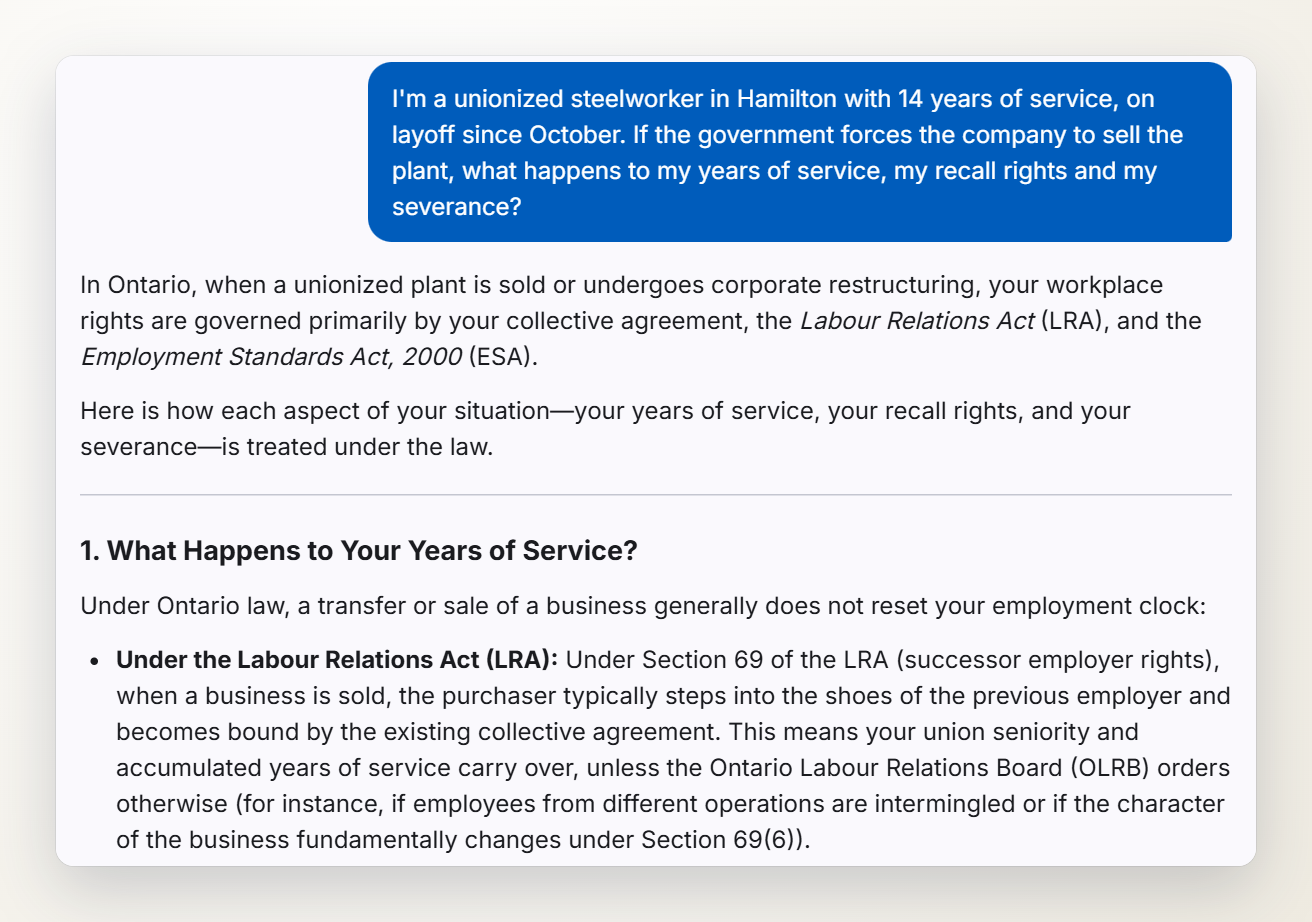
Keep every layoff letter with its date and talk to your steward first. If a new owner offers you a job, ask in writing whether it recognizes your service.
More: court decisions on the sale of a business →
Ontario Severance is independent and isn't a law firm; this is general information. From a chat or a calculator result, you can ask us for help finding an employment lawyer, and we reply within one business day.
Sources
- Employment Standards Act, 2000, ss. 9, 56, 63 and 67
- Labour Relations Act, 1995, s. 69
- Investment Canada Act, ss. 39 and 40
- A. v. Bombardier Inc., 2007 ONCA 233
- C.A.W. Local No. 27 v. London Machinery Inc., 2006 CanLII 8711 (ON CA): an ordinary recall clause doesn't extend a layoff under s. 56(2)(c)
- ScrapMonster (The Canadian Press): Cleveland-Cliffs CEO says he's prepared to fight Canada in court over Stelco layoffs (Oct. 12, 2026)
- The Globe and Mail: Joly warns Stelco owner of forced divestment if Ontario layoffs go ahead (Oct. 14, 2026)
- Global News: Stelco penalties including fines, forced sale possible over layoffs: Joly (Oct. 14, 2026)
- Buffalo Toronto Public Media: Stelco layoffs to move forward as US-based owner balks at Ontario's demands (Oct. 15, 2026)
- CBC News: Stelco's U.S. owner says steelmaker had 'strongest' quarter since acquisition as massive layoffs underway (Oct. 20, 2026)
- Industrial Info Resources: Cleveland-Cliffs touts U.S. outlook, defends Stelco actions (Oct. 20, 2026)
This article is general information about Ontario employment law, not legal advice. The law and its application change, and every case turns on its own facts: for advice about your situation, speak with an Ontario employment lawyer.