Know your rights
Stellantis strike mandate: 97% yes. What happens now
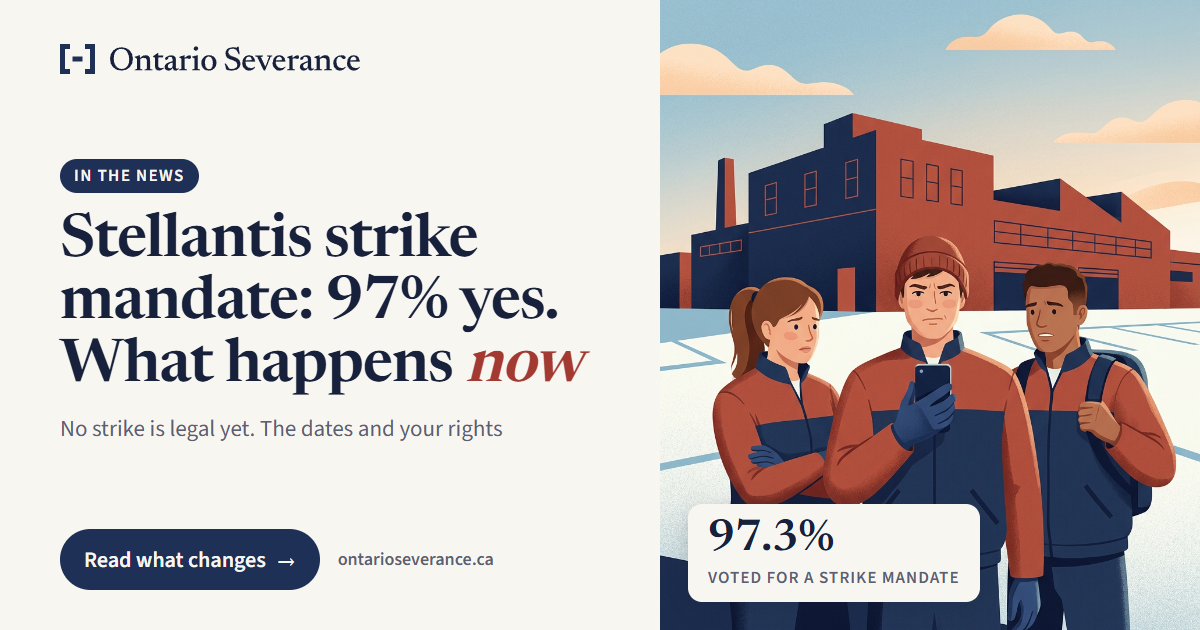
Unifor members at Stellantis have given their bargaining committee a strike mandate: 97.3% voted yes, the union announced on Monday, October 19. That doesn't start a strike, and no strike is legal yet. Here is what the vote changes for the more than 9,000 workers it covers, what it doesn't, and the dates to watch.
What happened
- October 17 and 18: Unifor members at Stellantis voted on a strike mandate (Unifor; INSAUGA).
- October 19: Unifor announced that 97.3% of those voting were in favour. It said the mandate "does not automatically mean a strike will occur" and that it is not in a legal strike position, because neither side has asked for a "no board" report (Unifor; The Globe and Mail; CBC News).
- The vote covers the Windsor Assembly Plant, the Etobicoke Casting Plant in Toronto, the idled Brampton plant and parts operations in Mississauga and Red Deer, Alberta (Unifor; The Globe and Mail). Ontario's law, below, applies to the Ontario workplaces.
- Stellantis told CBC News it "remains committed to bargaining in good faith." The Globe and Mail reports there have been no formal talks since September 11.
The dispute is still about Brampton. Unifor says Stellantis made a settlement for its other Canadian plants conditional on closing and selling the Brampton plant, which the union rejects. Stellantis says changing market and trade conditions undermined the plant's business case and that a sale to Roshel could support future work at the site (INSAUGA). About 2,200 Brampton workers remain on layoff (The Globe and Mail).

What the yes vote changes
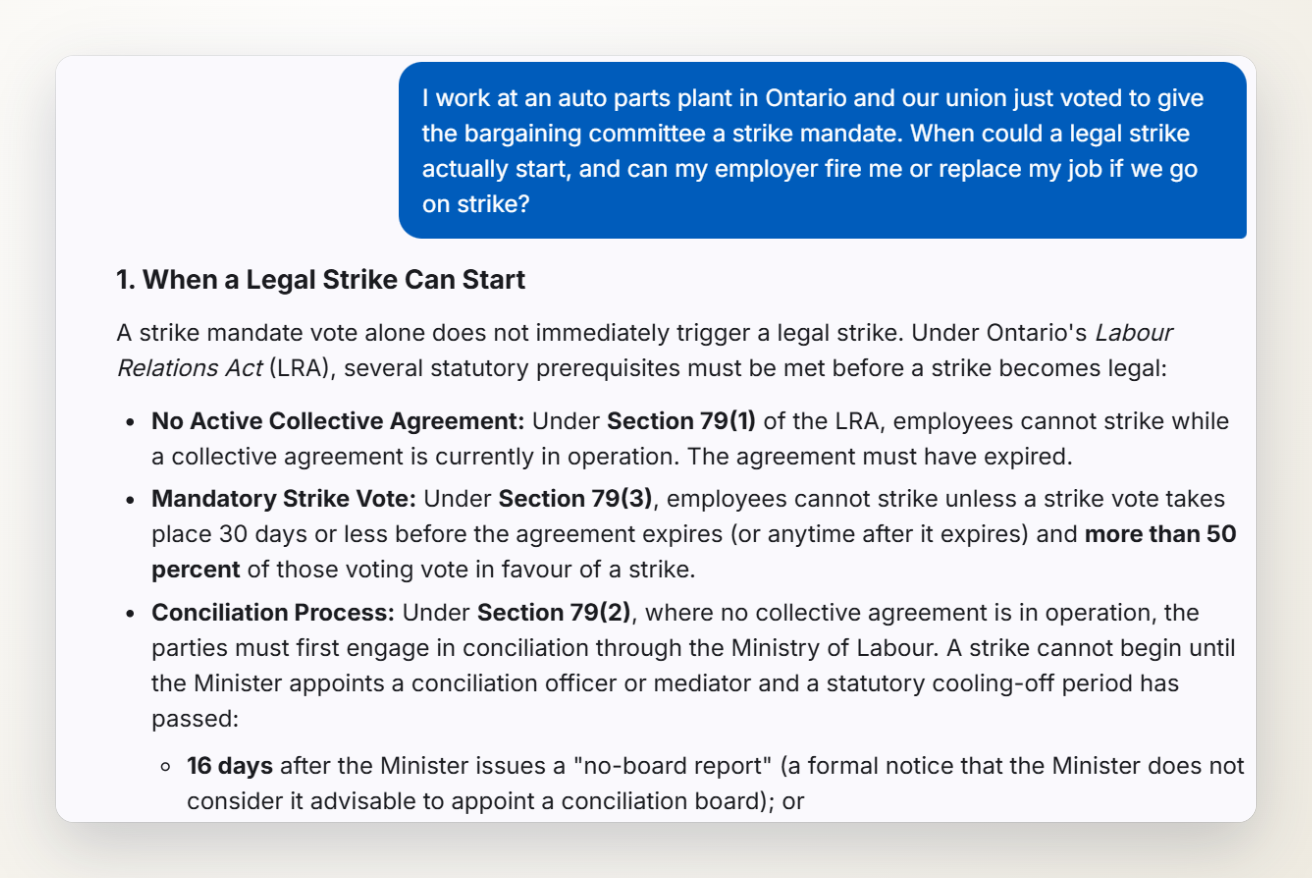
Under Ontario's Labour Relations Act, workers whose agreement has expired can only strike after a vote in which more than half of those voting say yes (s. 79(3)). That step is now done.
The timing step isn't. With no agreement in force, no strike or lockout is legal until a conciliation officer has been appointed and 16 days have passed after the Minister releases a notice that a conciliation board won't be appointed, the "no board" notice (s. 79(2)). Unifor said on September 24 that the parties are in conciliation, but neither has asked for that notice, so the earliest a legal strike could begin is the 17th day after it is released.
Meanwhile, Unifor says the terms of the expired agreement remain in effect. The Labour Relations Act backs this: the employer can't change wages or working conditions without the union's consent until 14 days after a "no board" notice is released (s. 86(1)).
Your job if a strike comes
- No firing without cause. From the day a strike or lockout becomes lawful until a new agreement, the employer can't discharge or discipline anyone in the bargaining unit without just cause, and the union can enforce this through grievance and arbitration (s. 80.1).
- A right to return. A striker who applies in writing, without conditions, within six months of the start of a lawful strike must be given their former job back, unless the employer no longer has anyone doing that kind of work or has stopped operations for cause. If operations resume, those who applied are recalled first (s. 80).
Our guide to the strike vote covers layoff weeks during a strike, Employment Insurance and what a Brampton sale would mean; for the Windsor layoffs, see our layoff guide.
What to watch
- A return to the table, or a request for a "no board" report: a legal strike could begin on the 17th day after the notice is released.
- Your steward first: in a union, the agreement and the grievance process are where your rights are enforced.
Working at a non-union supplier and worried about your job if the plants stop? Courts can award more than the minimum the Employment Standards Act sets, and the calculator shows both.
Court decisions involving unions →
Ontario Severance is independent and isn't a law firm; this is general information. From a chat or a calculator result, you can ask us for help finding an employment lawyer, and we reply within one business day.
Sources
- Unifor: Unifor members at Stellantis deliver overwhelming strike mandate (Oct. 19, 2026)
- Unifor: Stellantis members overwhelmingly support strike mandate (Oct. 19, 2026)
- Unifor: Update on Unifor-Stellantis negotiations (Sept. 24, 2026)
- The Globe and Mail: Stellantis workers hand Unifor leaders a strike mandate amid stalled talks (Oct. 19, 2026)
- CBC News: Unifor Stellantis workers in Ontario vote 97% in favour of strike mandate with talks still stalled (Oct. 19, 2026)
- INSAUGA: Strike mandate puts more pressure on Stellantis over future of Brampton plant (Oct. 19, 2026)
- Labour Relations Act, 1995, ss. 79, 80, 80.1 and 86
This article is general information about Ontario employment law, not legal advice. The law and its application change, and every case turns on its own facts: for advice about your situation, speak with an Ontario employment lawyer.