Know your rights
WSIB job cuts: the facts, the law and what to expect

Hundreds of Workplace Safety and Insurance Board employees got redundancy notices in August, and the cuts were back at Queen's Park this week. If you are one of them, you have a choice to make between an exit package and a move. Here is what has been reported, what the union contract and the Employment Standards Act say, and what to check before you decide.
The facts so far
- August 19: more than 460 WSIB employees were told their jobs were redundant. The Ontario Compensation Employees Union (OCEU/CUPE Local 1750) puts the number at 466, including 131 in Windsor and 238 in northern Ontario (Canadian Occupational Safety and CBC News, August 20 and 21).
- Offices: the WSIB told staff its offices in Thunder Bay, Sault Ste. Marie, Sudbury, North Bay, Timmins, Kingston, St. Catharines, Guelph and Windsor would not reopen. Work moves to London, Hamilton and the Greater Toronto Area. The union says 621 jobs are at risk once a planned closure of the Waterloo office next year is counted (Canadian Occupational Safety, August 20).
- The choice: employees were given two options, an exit package or a request to move to an office that is staying open; for Windsor, the nearest is London (CBC News, August 21). The union's president, Harry Goslin, said workers had three weeks to decide whether to relocate (Canadian Occupational Safety).
- The WSIB's position: it called the change "the difficult business decision to consolidate some claim and account management functions", and said affected employees get relocation opportunities, job search help and continued benefits, including unlimited mental health support (Canadian Occupational Safety; Kingstonist, August 20).
- October 20: at a news conference at Queen's Park, NDP MPPs Jamie West and Lise Vaugeois asked Ontario's Auditor General for a value-for-money audit of the restructuring, and Mr. Goslin said the WSIB "is in a crisis". By then the union and the NDP put the jobs affected at more than 700. The WSIB said local teams still give in-person support in Sudbury and across the north (CTV News, October 21; Ontario NDP, October 20).

What the agreement says
The WSIB's employees are covered by a collective agreement with OCEU. The agreement now in force came out of the tentative deal reached on July 5, 2025, which members ratified to end last year's strike (they went back to work on July 7), and its text isn't published. The last one the union has posted online, for May 2020 to April 2023, has expired, but it shows how redundancy has worked at the WSIB. Under its Article 6:
- Notice: at least 130 working days (about six months) before layoff, plus up to 130 working days of priority placement into open jobs.
- Voluntary Exit: 130 working days' pay, plus severance of 1.5 weeks per year of service (1 to 5 years), 2 weeks (6 to 14 years) or 2.5 weeks (15 years and more), six months of benefit premiums other than long-term disability, and the payout of attendance and vacation credits. If the offer isn't taken within 15 working days, the 130 days' pay shrinks by the days worked since the notice, after the first 15.
- Relocation: moving costs of up to $16,500, with receipts, to a job no more than two salary grades lower, when the new commute would be at least 40 km longer.
- Layoff: someone who can't be placed or bump a less senior employee is laid off with recall rights for as long as their seniority, up to 24 months, and can take the severance at any time instead.
- A warning: refusing a permanent placement in your own area, or in a place you said you'd move to, counts as ending your employment, with the remainder of the severance paid.
Ask your steward whether the 2025 agreement changed any of these figures. The union says it was consulted before the notices went out and negotiated some measures to soften the impact (Canadian Occupational Safety).
What the law adds
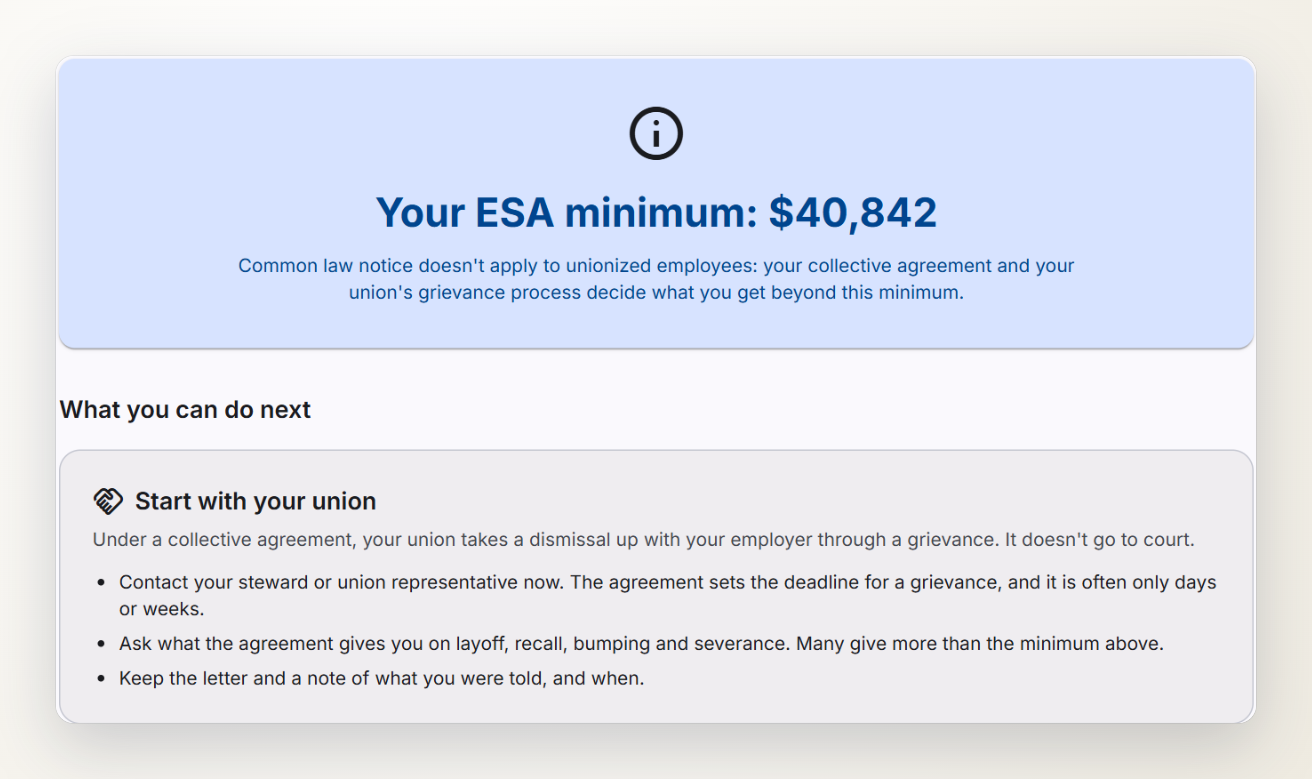
The Employment Standards Act, 2000 applies to the WSIB as an employer, so it sets a floor here too. A contract that gives more than the Act on the same subject replaces it; one that gives less doesn't count (s. 5).
- Notice or termination pay: up to 8 weeks by length of service (s. 57). When 50 or more people are let go at one establishment within four weeks, the minimum rises to 8, 12 or 16 weeks depending on how many (s. 58 and O. Reg. 288/01, s. 3).
- Severance pay: with 5 years of service and an employer payroll of $2.5 million or more, one week's pay per year, up to 26 weeks (ss. 64 and 65). A contract payment based on service can be deducted from it (s. 65(8)), so you don't collect both in full.
- Turning down another job: the Act's termination pay and severance pay aren't owed to someone whose job ends after they refuse "reasonable alternative employment" with the employer, or alternative employment made available through a seniority system (O. Reg. 288/01, ss. 2(1) and 9(1)). The rule doesn't say how far away a job can be and still be reasonable, which is a question for your union.
- Recall rights: someone laid off with a right to be recalled who becomes entitled to termination or severance pay can take the money now, giving up recall, or keep the recall rights (s. 67).
- Enforcement: for a unionized employee, the Act is enforced through the grievance procedure, not a complaint to the Ministry (s. 99).
How courts have ruled
In London Machinery (2006), the Court of Appeal held that a unionized worker who had not been recalled within 35 weeks of a layoff was owed termination pay under the Act, even though the collective agreement kept his recall rights for two years. A recall clause extends a temporary layoff only if the employer actually recalls the worker in time, and the Act lets the worker choose between the money and the recall rights (s. 67).
On October 1, 2026, in N. v. Liquor Control Board of Ontario, the Divisional Court refused to review the termination of a unionized employee of another provincial agency: the court had no jurisdiction, and the employee's recourse was the grievance the union was pursuing. For WSIB staff too, disputes under a collective agreement go to grievance arbitration, not to court (Weber v. Ontario Hydro, Supreme Court of Canada, 1995).
What to expect
- Talk to your steward first about the deadlines in your notice, the exit package and any placement or bump you are offered.
- Before you refuse a placement or a move, ask whether it would cost you the agreement's severance or the Act's termination and severance pay.
- Get your numbers. The calculator gives the Act's minimum for your service and pay, which the agreement must at least match.
- Waterloo staff: the closure there is planned for next year, according to the union. The same rules will apply when notices go out.
Read more about collective agreements and severance pay, or browse Court Cases.
Ontario Severance is independent and not a law firm; this is general information. From a calculator result or a chat, you can ask us for help finding an employment lawyer, and we reply within one business day.
Sources
- Canadian Occupational Safety, "WSIB cuts hundreds of jobs and closes nine offices" (August 20, 2026)
- CBC News, "Windsor WSIB employee feels 'anger,' 'devastation' over redundancy notices" (August 21, 2026)
- Kingstonist, "Union says WSIB to axe 600+ jobs and shutter 10 regional offices, including Kingston" (August 20, 2026)
- CTV News (Angela Gemmill), "WSIB job cuts causing a 'crisis,' union says" (October 21, 2026)
- Ontario NDP, "Ontario NDP calls on Auditor General to investigate WSIB office closures and impact on the North" (October 20, 2026)
- WSIB, "WSIB and OCEU reach tentative agreement to end labour disruption" (July 5, 2025)
- CUPE, "OCEU/CUPE 1750 members vote 'yes' to ratify tentative agreement" (July 7, 2025)
- Collective agreement between OCEU (CUPE Local 1750) and the WSIB, May 1, 2020 to April 30, 2023 (expired), Article 6
- Employment Standards Act, 2000, ss. 5, 57, 58, 64, 65, 67 and 99
- O. Reg. 288/01 (Termination and Severance of Employment), ss. 2, 3 and 9
- National Automobile, Aerospace Transportation and General Workers Union of Canada (C.A.W. - Canada) Local No. 27 v. London Machinery Inc., 2006 CanLII 8711 (ON CA)
- N. v. Liquor Control Board of Ontario, 2026 ONSC 5520 (CanLII)
- Weber v. Ontario Hydro, [1995] 2 S.C.R. 929
This article is general information about Ontario employment law, not legal advice. The law and its application change, and every case turns on its own facts: for advice about your situation, speak with an Ontario employment lawyer.