Know your rights
Stellantis Brampton plant sold? What laid-off workers can do
Unifor says it believes Stellantis has sold the idled Brampton Assembly Plant to Roshel, a maker of armoured vehicles. Stellantis hasn't confirmed a sale. For the workers who have been on layoff for almost three years, here is what is new, what a sale would change, and a choice Ontario law already gives you.
What happened
- November 3: Stellantis told Unifor it was still talking with the federal government and had not sold the plant, the union said in its November 4 update. The union said the company remains on the path to close and sell it.
- November 5: Ontario and the federal government agreed to the union's request for a meeting with Stellantis, Unifor said. No date is set.
- November 6: after another meeting, Unifor said Stellantis would neither confirm nor deny that the sale was final, and that it takes the refusal as confirmation that the plant has been sold (The Globe and Mail, Global News).
- The Globe and Mail cited an unnamed source who said a sale would be announced early this week, with Roshel buying the plant and leasing it back for production. Stellantis said it had nothing to announce, and Roshel declined to comment.
Unifor represents about 3,000 Brampton workers who were laid off almost three years ago, The Globe and Mail reports; Global News says more than 2,000 were laid off when the plant stopped in 2023. Our earlier articles cover the strike vote and the sale rules and the 97% strike mandate.

What a sale would change
If an employer bound by a collective agreement sells its business, the buyer is bound by that agreement until the Ontario Labour Relations Board declares otherwise, and a lease counts as a sale (Labour Relations Act, s. 69(1) and (2)).
Who would employ anyone at the plant after a sale and lease-back hasn't been reported. Until that is known, nothing in the reports changes the rights below.
The choice you may already have
Under the Employment Standards Act, a layoff of 35 weeks or more in 52 ends your job in law, unless you are in a union and are recalled within the time your collective agreement sets (s. 56(1)(c) and (2)(c)). For severance pay the rule is simpler: 35 weeks of layoff in 52 severs the job, recall rights or not (s. 63(1)(c)).
The Court of Appeal applied this in C.A.W. Local No. 27 v. London Machinery Inc., 2006 CanLII 8711 (ON CA). A unionized welder had two years of recall rights but hadn't been recalled when his layoff passed 35 weeks. The court held that his job was then deemed terminated, that he was owed termination pay, and that he should have been offered the election the Act gives.
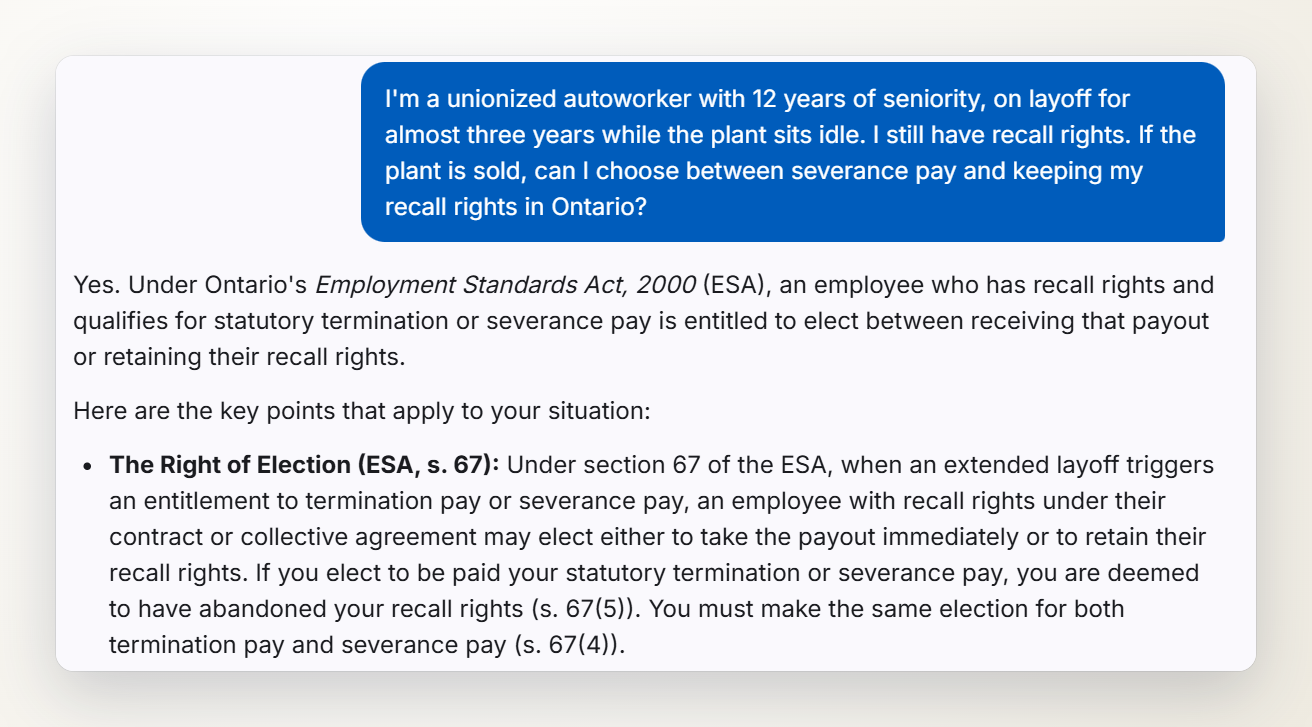
That election is in s. 67. An employee with recall rights who is owed termination pay for a layoff of 35 weeks or more, or severance pay, can take the money now or keep the right to be recalled. Taking the money gives up recall, and you make the same choice for both payments. If you keep recall or don't choose, the money is held in trust under an arrangement between the employer and the union, or by the Director of Employment Standards. It goes to you if your recall right expires or you give it up, and back to the employer if you accept a recall (s. 67(3) to (9)).
Severance pay is owed with five years or more of employment at an employer with a payroll of $2.5 million or more (s. 64(1)). It is a week's regular wages per year of employment, plus a share for months of a partial year, up to 26 weeks (s. 65).
What the agreement says
The full Stellantis agreement in force before September 2026 isn't public. The earlier 2020 Production and Maintenance Agreement, which covered Brampton Assembly, set these points:
- Seniority ended after 60 months in a row without work, or a period equal to your seniority when you last worked, whichever is longer (clause 5.3).
- On a plant closure, employees with 5 or more years of seniority could apply for a lump sum under the Voluntary Termination of Employment Plan, and others had SUB and placement at other plants (letter 17.11).
Your Unifor local has the current text and how it fits with the Act.
What to do now
- Talk to your steward first. In a union, the Act is enforced through the collective agreement and a grievance (ESA s. 99).
- Ask where your termination and severance pay stand: whether you have been offered the s. 67 election, and whether money is held in trust for you.
- Watch for the announcement the Globe and Mail's source expects this week, and the date of the meeting with both governments.
At a non-union supplier and losing work because of the plant? Courts can award more than the minimum the Act sets, and the calculator shows both.
More: court decisions on temporary layoffs.
Ontario Severance is independent and isn't a law firm; this is general information. From a chat or a calculator result, you can ask us for help finding an employment lawyer, and we reply within one business day.
Sources
- The Globe and Mail: Unifor believes Stellantis has finalized sale of Brampton assembly plant to Roshel (Nov. 6, 2026)
- Global News: Unifor says it believes Stellantis sold its Brampton plant (Nov. 7, 2026)
- Unifor: Update on meeting with Stellantis (Nov. 4, 2026)
- Unifor: Governments agree to meet on Stellantis' future (Nov. 5, 2026)
- C.A.W. Local No. 27 v. London Machinery Inc., 2006 CanLII 8711 (ON CA)
- Employment Standards Act, 2000, ss. 9, 56, 63, 64, 65, 67 and 99 (current to Nov. 4, 2026)
- Labour Relations Act, 1995, s. 69
- Agreement between FCA Canada Inc. and Unifor, Production and Maintenance (2020; expired 2023)
This article is general information about Ontario employment law, not legal advice. The law and its application change, and every case turns on its own facts: for advice about your situation, speak with an Ontario employment lawyer.